Spanish Art Made by the Spanish Drawn or Painted Old
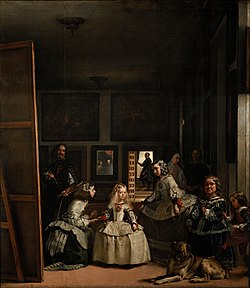
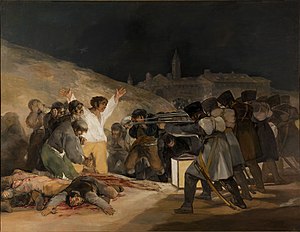
Castilian art has been an important contributor to Western art and Spain has produced many famous and influential artists including Velázquez, Goya and Picasso. Spanish art was particularly influenced by France and Italy during the Bizarre and Neoclassical periods, but Spanish fine art has often had very distinctive characteristics, partly explained past the Moorish heritage in Spain (peculiarly in Andalusia), and through the political and cultural climate in Spain during the Counter-Reformation and the subsequent eclipse of Castilian power under the Bourbon dynasty.
The prehistoric art of Kingdom of spain had many of import periods-information technology was 1 of the principal centres of European Upper Paleolithic art and the rock art of the Spanish Levant in the subsequent periods. In the Atomic number 26 Historic period large parts of Spain were a center for Celtic art, and Iberian sculpture has a distinct style, partly influenced by coastal Greek settlements. Spain was conquered by the Romans by 200 BC and Rome was rather smoothly replaced past the Germanic Visigoths in the 5th century AD, who soon Christianized. The relatively few remains of Visigothic art and architecture show an bonny and distinct version of wider European trends. With the Umayyad conquest of Hispania in the 8th century there was a notable Moorish presence in fine art specially in Southern Iberia. Over the following centuries the wealthy courts of Al-Andalus produced many works of exceptional quality, culminating in the Alhambra in Granada, right at the end of Muslim Spain.
Meanwhile, the parts of Spain remaining Christian, or that were re-conquered, were prominent in Pre-Romanesque and Romanesque art. Tardily Gothic Spanish art flourished nether the unified monarchy in the Isabelline Gothic and Plateresque styles, and the already strong traditions in painting and sculpture began to benefit from the influence of imported Italian artists. The enormous wealth that followed the alluvion of American gold saw lavish spending on the arts in Kingdom of spain, much of it directed at religious art in the Counter-Reformation. Spanish control of the leading middle of North European art, Flanders, from 1483 and also of the Kingdom of Naples from 1548, both ending in 1714, had a great influence on Spanish fine art, and the level of spending attracted artists from other areas, such as El Greco, Rubens and (from a prophylactic distance) Titian in the Spanish Aureate Age, as well equally cracking native painters such equally Diego Velázquez, José de Ribera, Francisco de Zurbarán and Bartolomé Esteban Murillo.
Spanish Baroque compages has survived in large quantity, and has both strains marked past exuberant extravagance, as in the Churrigueresque style, and a rather severe classicism, as in the piece of work of Juan de Herrera. It was generally the former which marked the emerging art and Spanish Colonial architecture of the Spanish Empire outside Europe, as in Latin America (New Spanish Bizarre and Andean Bizarre), while the Baroque Churches of the Philippines are simpler. The decline of the Habsburg monarchy brought this menstruum to an finish, and Spanish art in the 18th and early on-19th century was generally less exciting, with the huge exception of Francisco Goya. The balance of 19th-century Spanish fine art followed European trends, generally at a bourgeois footstep, until the Catalan movement of Modernisme, which initially was more than a form of Fine art Nouveau. Picasso dominates Spanish Modernism in the usual English sense, but Juan Gris, Salvador Dalí and Joan Miró are other leading figures.
Ancient Iberia [edit]

The early Iberians accept left many remains; northern-western Spain shares with south-western French republic the region where the richest Upper Paleolithic art in Europe is found in the Cave of Altamira and other sites where there are cave paintings made between 35,000 and eleven,000 BC.[1] The Rock art of the Iberian Mediterranean Bowl (equally UNESCO term information technology) is from the eastern side of Kingdom of spain, probably dating from about 8000-3500 BC, and shows beast and hunting scenes often developed with a growing feeling for the whole composition of a large scene.[2] Portugal in particular is rich in megalithic monuments, including the Almendres Cromlech, and Iberian schematic fine art is stone sculpture, petroglyphs and cavern paintings from the early metal ages, found all over the Iberian peninsula, with both geometric patterns, simply also a higher usage of unproblematic pictogram-like human figures than is typical of comparable art from other areas.[3] The Casco de Leiro, a late Statuary Historic period aureate ritual helmet, may chronicle to other golden hats found in Germany, and the Treasure of Villena is a huge hoard of geometrically decorated vessels and jewellery, possibly from the 10th century BC, including 10 kilos of gold.
Iberian sculpture before the Roman occupation reflects the contacts with other advanced ancient cultures who ready small coastal colonies, including the Greeks and Phoenicians; the Sa Caleta Phoenician Settlement on Ibiza has survived to be excavated, where most now lie under large towns, and the Lady of Guardamar was excavated from another Phoenician site. The Lady of Elche (probably 4th century BC) possibly represents Tanit, but besides shows Hellenistic influence, as do the 6th century Sphinx of Agost and Biche of Balazote. The Bulls of Guisando are the most impressive examples of verracos, which are large Celtiberian brute sculptures in rock; the 5th century BC Bull of Osuna is a more developed unmarried instance. Some decorated falcata, the distinctive curving Iberian sword, take survived, and large numbers of statuary statuettes used equally votive offerings. The Romans gradually conquered all of Iberia betwixt 218 BC and xix Advertisement.[4]
Equally elsewhere in the Western Empire, the Roman occupation largely overwhelmed native styles; Iberia was an of import agricultural area for the Romans, and the aristocracy acquired vast estates producing wheat, olives and vino, with some later emperors coming from the Iberian provinces; many huge villas take been excavated. The Aqueduct of Segovia, Roman Walls of Lugo, Alcántara Bridge (104–106 Ad), and the Belfry of Hercules lighthouse are amidst a number of well-preserved major monuments, impressive remains of Roman engineering if not always fine art. Roman temples survive fairly complete at Vic, Évora (at present in Portugal), and Alcántara, likewise as elements in Barcelona and Córdoba. There must have been local workshops producing the loftier-quality mosaics found, though near of the ameliorate costless-standing sculpture was probably imported.[five] The Missorium of Theodosius I is an important Late Antique silver dish that was establish in Kingdom of spain but was probably made in Constantinople.

Early on Medieval [edit]

The Christianized Visigoths ruled Iberia afterwards the collapse of the Empire, and the rich 7th century Treasure of Guarrazar, probably deposited to avoid looting in the Muslim Conquest of Spain, is now a unique survival of Christian votive crowns in gilded; though Spanish in fashion, the form was probably and so used by elites beyond Europe. Other Visigothic art in the form of metalwork, mostly jewellery and buckles, and stone reliefs, survives to give an idea of the culture of this originally barbarian Germanic people, who kept themselves very largely separate from their Iberian subjects, and whose dominion crumbled when the Muslims arrived in 711.[7]
The jewelled crux gemmata Victory Cantankerous, La Cava Bible and the Agate Casket of Oviedo are survivals from the 9-tenth century of the rich Pre-Romanesque civilisation of the Asturias region in n-western Spain, which remained under Christian rule; the Santa María del Naranco banqueting house overlooking Oviedo, completed in 848 and later surviving equally a church, is a unique survival in Europe. The Codex Vigilanus, completed in 976 in the region of Rioja, shows a complex mixture of several styles.[8]
Muslim and Mozarab Spain [edit]

The extraordinary palace-city of Medina Azahara most Córdoba was built in the 10th century for the Ummayad Caliphs of Córdoba, intended equally the capital of Islamic Andaluz, and is still being excavated. A considerable amount of the highly sophisticated ornament of the primary buildings has survived, showing the enormous wealth of this very centralized country. The palace at Aljafería is later, from afterward Islamic Spain split into a number of kingdoms. Famous examples of Islamic architecture and its ornamentation are the Cathedral–Mosque of Córdoba, whose Islamic elements were added in stages between 784 and 987, and the Alhambra and Generalife palaces in Granada from the final periods of Muslim Espana.[9]
The Pisa Griffin is the largest known Islamic sculpture of an creature, and the near spectacular of a grouping of such figures from Al-Andalus, many made to concur upwards the basins of fountains (as at the Alhambra), or in smaller cases as perfume-burners and the like.
The Christian population of Muslim Kingdom of spain (the Mozarabs) developed a style of Mozarabic art whose best known survivals are a series of illuminated manuscripts, several of the commentaries on the Book of Revelation by the Asturian Saint Beatus of Liébana (c. 730 – c. 800), which gave subject field matter that allowed the brightly coloured primitivist style full scope to demonstrate its qualities in manuscripts of the 10th century like the Morgan Beatus, probably the earliest, the Gerona Beatus (illuminated past a female person artist Ende), Escorial Beatus and the Saint-Sever Beatus, which was actually produced some distance from Muslim rule in French republic. Mozarabic elements, including a background of brightly coloured strips, can exist seen in some after Romanesque frescos.[10]
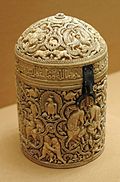
Hispano-Moresque ware pottery began in the due south, presumably mainly for local markets, but Muslim potters were later encouraged to drift to the Valencia region, where the Christian lords marketed their luxury lustrewares to elites all over Christian Europe in the 14th and 15th centuries, including the Popes and the English language court. Castilian Islamic ivory carving and textiles were also very fine; the continuing industries producing tiles and carpets in the peninsula owe their origins largely to the Islamic kingdoms.[11]
Later on the expulsion of the Islamic rulers during the Reconquista, considerable Muslim populations, and Christian craftsmen trained in Muslim styles, remained in Spain, and Mudéjar is the term for piece of work in art and architecture produced by such people. The Mudéjar Compages of Aragon is recognised as a UNESCO World Heritage Site, and the 14th century Patio de las Doncellas built for Peter of Castile in the Alcázar of Seville is another outstanding case. The style could harmonize well with Christian European medieval and Renaissance styles, for example in elaborate forest and stucco ceilings, and Mudéjar work often continued to be produced for some centuries after an area passed to Christian rule.[12]
Painting [edit]
Romanesque [edit]
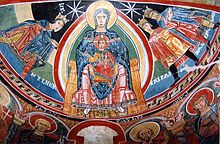
In Spain, the art of the Romanesque period represented a smooth transition from the preceding Pre-Romanesque and Mozarabic styles. Many of the best surviving Romanesque church frescos that were at the fourth dimension institute all over Europe come from Catalonia with good examples in the churches of the Vall de Boí area; many of these were only uncovered during the 20th Century.[13] Some of the best examples have been moved to museums, especially the Museu Nacional d'Art de Catalunya in Barcelona, which has the famous Primal Alcove from Sant Climent in Taüll and the frescos from Sigena. The finest examples of Castillian Romanesque frescoes are considered to exist those in the San Isidoro in Leon, the paintings from San Baudelio de Berlanga, now mostly in various museums including the Metropolitan Museum of Fine art in New York, and those from Santa Cruz de Maderuelo in Segovia.[14] In that location are also a number of altar frontals painted on wood and other early console paintings.
Gothic [edit]
The Gothic art of Spain represented a gradual development from previous Romanesque styles, being led by external models, first from France, and and then later from Italia. Another distinctive aspect was the incorporation of Mudejar elements. Eventually the Italian influence, which transmitted Byzantine stylistic techniques and iconography, entirely displaced the initial Franco-Gothic fashion[15] Catalonia continued to be a prosperous area which has left many fine altarpieces; still the region went into decline after the emphasis of trade moved to the Atlantic afterward the American colonies opened upwardly, which partly accounts for so many medieval survivals there, as there was not the money for Renaissance and Baroque renovations to churches.
Early Renaissance [edit]
Due to important economic and political links between Kingdom of spain and Flemish region from the mid-15th century onwards, the early on Renaissance in Spain was heavily influenced by Netherlandish painting, leading to the identification of a Hispano-Flemish schoolhouse of painters. Leading exponents included Fernando Gallego, Bartolomé Bermejo, Pedro Berruguete and Juan de Flandes.
Renaissance and Mannerism [edit]

Overall the Renaissance and subsequent Mannerist styles are hard to categorise in Spain, due to the mix of Flemish and Italian influences, and regional variations.[16]
The master centre for Italian Renaissance influence entering Espana was Valencia due to its proximity and shut links with Italia. This influence was felt via so import of artworks, including four paintings by Piombo and many prints by Raphael, the arrival of the Italian Renaissance artist Paolo de San Leocadio,[17] and likewise past Spanish artists who spent time working and preparation there. Such artists included Fernando Yáñez de la Almedina (1475–1540) and Fernando Llanos, who displayed Leonadesque features in their works, such as fragile, melancholic expressions, and sfumato modelling of features.[xviii]
Elsewhere in Spain, the influence of the Italian Renaissance was less pure, with a relatively superficial use of techniques that were combined with preceding Flemish practices and incorporated Mannerist features, due to the relatively late examples from Italian republic, once Italian art was already strongly Mannerist.[nineteen] Apart from technical aspects, the themes and spirit of the Renaissance were modified to the Spanish culture and religious environs. Consequently, very few classical subjects or female nudes were depicted, and the works frequently exhibited a sense of pious devotion and religious intensity – attributes that would remain dominant in much art of Counter Reformation Spain throughout the 17th century, and beyond. artists included Vicente Juan Masip (1475–1550) and his son Juan de Juanes (1510–1579), the painter and builder Pedro Machuca (1490–1550), and Juan Correa de Vivar (1510–1566). However, the near popular Spanish painter of the early 17th Century was Luis de Morales (1510?–1586), called past his contemporaries "The Divine", because of the religious intensity of his paintings.[twenty] From the Renaissance he too oftentimes used sfumato modeling, and simple compositions, but combined them with Flemish style precision of details. His subjects included many devotional images, including the Virgin and Child.
Aureate Age [edit]
The Spanish Golden Historic period, a period of Castilian political ascendancy and subsequent turn down, saw a neat development of fine art in Spain.[21] The menses is generally considered to have begun at some point afterwards 1492 and ended by or with the Treaty of the Pyrenees in 1659, though in art the get-go is delayed until the reign of Philip Iii (1598-1621), or just before, and the end too delayed until the 1660s or later. The style thus forms a part of the wider Baroque menstruum in art, although as well as considerable influence from great Baroque masters such as Caravaggio and later Rubens, the distinctive nature of the art of the catamenia besides included influences that modified typical Baroque characteristics.[22] These included influence from gimmicky Dutch Golden Age painting and the native Castilian tradition which give much of the fine art of the period an interest in naturalism, and an avoidance of the grandiosity of much Bizarre art. Important early contributors included Juan Bautista Maíno (1569–1649), who brought a new naturalistic manner into Espana,[23] Francisco Ribalta (1565–1628),[24] and the influential all the same life painter, Sánchez Cotán (1560–1627).[25]
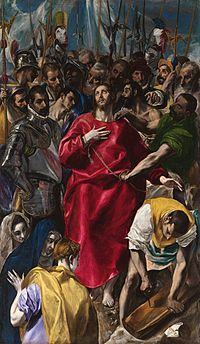
El Greco (1541–1614) was one of the nearly individualistic of the painters of the menstruum, developing a strongly Mannerist mode based on his origins in the postal service Byzantine Cretan schoolhouse, in contrast to the naturalist approaches then predominant in Seville, Madrid and elsewhere in Spain.[26] Many of his works reflect the silvery-greys and strong colours of Venetian painters such as Titian, but combined with strange elongations of figures, unusual lighting, disposing of perspective infinite, and filling the surface with very visible and expressive brushwork.[27]
Although mostly active in Italy, particularly in Naples, José de Ribera (1591–1652) considered himself Spanish, and his style is sometimes used every bit an example of the extremes of Counter-Reformation Spanish art. His work was very influential (largely through the apportionment of his drawing and prints throughout Europe) and developed significantly through his career.[28]
Being the gateway to the New Earth, Seville became the cultural eye of Spain in the 16th Century, and attracted artists from across Europe, drawn by lure of commissions for the growing empire, and for the numerous religious houses of the wealthy city.[29] Starting from a strongly Flemish tradition of detailed and smooth brushwork, as revealed in the works of Francisco Pacheco (1564–1642), over time a more naturalistic approach developed, with the influence of Juan de Roelas (c. 1560–1624) and Francisco Herrera the Elder (1590–1654). This more than naturalistic arroyo, influenced past Caravaggio, became predominant in Seville, and formed the training background of 3 Gold Age masters: Cano, Zurbarán and Velázquez.[30]
Francisco de Zurbarán (1598–1664) is known for the forceful, realistic use of chiaroscuro in his religious paintings and still lifes. Although seen as limited in his development, and struggling to handle circuitous scenes. Zurbarán's great power to evoke religious feelings fabricated him very successful in receiving commissions in bourgeois Counter-Reformation Seville.[31]
Sharing the same painting chief - Francisco Pacheco - as Velázquez, Alonso Cano (16601–1667) was as well agile in sculpture and architecture. His way moved from the naturalism of his early period, to a more than delicate, idealistic arroyo, revealing Venetian and van Dyck influences.[32]
Velázquez [edit]
Diego Velázquez (1599–1660) was the leading artist in the court of King Philip IV. In add-on to numerous renditions of scenes of historical and cultural significance, he created scores of portraits of the Castilian imperial family, other notable European figures, and commoners. In many portraits, Velázquez gave a dignified quality to less fortunate members of society similar beggars and dwarfs. In dissimilarity to these portraits, the gods and goddesses of Velázquez tend to exist portrayed equally common people, without divine characteristics. Besides the forty portraits of Philip by Velázquez, he painted portraits of other members of the royal family, including princes, infantas (princesses), and queens.[33]
After Baroque [edit]
Later Bizarre elements were introduced as a foreign influence, through visits to Spain by Rubens, and the apportionment of artists and patrons between Spain and the Spanish possessions of Naples and the Spanish Netherlands. Significant Spanish painters taking up the new style were Juan Carreño de Miranda (1614–1685), Francisco Rizi (1614–1685) and Francisco de Herrera the Younger (1627–1685), son of Francisco de Herrera the Elder an initiator of the naturalist emphasis of the Seville Schoolhouse. Other notable Baroque painters were Claudio Coello (1642–1693), Antonio de Pereda (1611–1678), Mateo Cerezo (1637–1666) and Juan de Valdés Leal (1622–1690).[34]
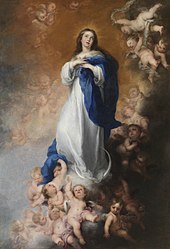
The pre-eminent painter of the flow - and almost famous Castilian painter prior to the 19th century appreciation of Velázquez, Zurbarán and El Greco - was Bartolomé Esteban Murillo (1617–1682).[35] Working for most of his career in Seville, his early work reflected the naturalism of Caravaggio, using a subdued, brown palette, simple but not harsh lighting, and religious themes that are portrayed in a natural or domestic setting, as in his Holy Family with a Little Bird (c. 1650).[36] Afterwards he incorporated elements of the Flemish Baroque from Rubens and Van Dyck. In the Soult Immaculate Conception, a brighter and more radiant colour range is used, the swirling cherubs bringing all the focus upon the Virgin, whose heavenward gaze and lengthened and warmly glowing halo brand it an effective devotional image, an of import component of his output; the Immaculate Formulation of the Virgin theme alone was represented about twenty times by Murillo.[37]
18th century [edit]

The starting time of the Bourbon dynasty in Spain under Philip 5 led to bully changes in art patronage, with the new French-oriented court favoring the styles and artists of Bourbon French republic. Few Spanish painters were employed by the court – a rare exception being Miguel Jacinto Meléndez (1679–1734) – and it took some time before Spanish painters adjusted to the new Rococo and Neoclassical styles. Leading European painters, including Giovanni Battista Tiepolo and Anton Raphael Mengs, were active and influential.[38]
Restricted from royal sponsorship, many Spanish painters continued the Baroque way in religious compositions. This was truthful of Francisco Bayeu y Subias (1734–1795), a skilled fresco painter, and of Mariano Salvador Maella (1739–1819) who both adult in the direction of the severe Neoclassicism of Mengs.[39] Another important avenue for Spanish artists was portraiture, which was an active sphere for Antonio González Velázquez (1723–1794), Joaquín Inza (1736–1811) and Agustín Esteve (1753–1820).[40] Merely it is in the genre of the still life that regal patronage was also successfully institute, in the works by artists such as the court painter Bartolomé Montalvo (1769–1846)[41] and Luis Egidio Meléndez (1716–1780).
Continuing in the Spanish still life tradition of Sánchez Cotán and Zurbarán, Meléndez produced a series of chiffonier paintings, deputed by the Prince of Asturias, the future Rex Charles 4, intended to show the full range of edible foods from Kingdom of spain. Rather than being but formal studies in Natural History, he used stark lighting, low viewpoints and severe compositions to dramatise the subjects. He showed great involvement and attention to the details of reflections, textures and highlights (such the highlight on the patterned vase in Yet Life with Oranges, Jars, and Boxes of Sweets) reflecting the new spirit of the age of Enlightenment.[42]
Goya [edit]

Francisco Goya was a portraitist and court painter to the Spanish Crown, a chronicler of history, and, in his unofficial work, a revolutionary and a visionary. Goya painted the Spanish royal family, including Charles IV of Espana and Ferdinand 7. His themes range from merry festivals for tapestry, draft cartoons, to scenes of state of war, fighting and corpses. In his early stage, he painted draft cartoons as templates for tapestries and focused on scenes from everyday life with vivid colors. During his lifetime, Goya besides made several series of grabados, etchings which depicted the decadence of society and the horrors of state of war. His most famous painting series are the Blackness Paintings, painted at the end of his life. This series features works that are obscure in both color and meaning, producing uneasiness and stupor.
He is considered the most important Spanish artist of late 18th and early 19th centuries and throughout his long career was a commentator and chronicler of his era. Immensely successful in his lifetime, Goya is often referred to as both the final of the Old Masters and the first of the moderns.
19th century [edit]

Frederico Pradilla, Doña Juana La Loca (Joan the Mad). Museo del Prado.
Various art movements of the 19th Century influenced Spanish artists, largely through them undertaking training in foreign capitals, particularly in Paris and Rome. In this fashion Neo-classicism, Romanticism, Realism and Impressionism became of import strands. However, they were frequently delayed or transformed by local conditions, including repressive governments, and past the tragedies of the Carlist Wars.[43] Portraits and historical subjects were pop, and the fine art of the past - peculiarly the styles and techniques of Velázquez - were significant.
Early years were still dominated past the academicism of Vincente López (1772–1850) and then the Neoclassicism of the French painter, Jacques-Louis David, as in the works by José de Madrazo (1781–1859), the founder of an influential line of artists and gallery directors. His son, Federico de Madrazo (1781–1859), was a leading figure in Spanish Romanticism, together with Leonardo Alenza (1807–1845), Valeriano Bécquer and Antonio María Esquivel.[44]
The later part of the century saw a strong menstruum of Romanticism represented in history paintings, as in the works of Antonio Gisbert (1834–1901), Eduardo Rosales (1836–1873) and Francisco Pradilla (1848–1921). In these works the techniques of Realism were frequently used with Romantic subjects. This can clearly be seen in Joan the Mad, a famed early work by Pradilla. The composition, facial expressions, and stormy sky reflect the dramatic emotion of the scene; even so the precise wearable, the texture of the mud, and other details, show bully realism in the artist's mental attitude and manner.[45] Mariano Fortuny(1838–1874) besides developed a stiff Realist style, afterward earlier beingness influenced past the French Romantic Eugène Delacroix, and became Kingdom of spain's famous artist of the century[46]
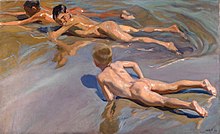
Joaquín Sorolla (1863–1923) excelled in the dexterous representation of the people and landscape under the sunlight of his native state, thus reflecting the spirit of Impressionism in many paintings, particularly his famous seaside paintings. In Children on the beach he makes the reflections, shadows and gloss of the water and skin his true subject field. The composition is very daring, with the horizon omitted, ane of the boys cut off, and potent diagonals leading to the contrasts and increased saturation of the upper-left of the work.[47]
20th century [edit]


During the first one-half of 20th century many leading Spanish artists were working in Paris, where they contributed to - and sometimes led - developments in the Modernist art movement.[48] As maybe the virtually of import case of this, Picasso, working together with the French creative person Braque, created the concepts of Cubism; and the sub-movement of Synthetic Cubism has been judged to have found its purest expression in the paintings and collages of Madrid-born Juan Gris.[49] In a similar way, Salvador Dalí became a key figure of the Surrealist movement in Paris; and Joan Miró was influential in abstract art.
Picasso's Bluish Menstruation (1901–1904), which consisted of somber, blue-tinted paintings was influenced by a trip through Spain. The Museu Picasso in Barcelona features many of Picasso'due south early works, created while he was living in Kingdom of spain, as well as the all-encompassing drove of Jaime Sabartés, Picasso's close friend from his Barcelona days who, for many years, was Picasso's personal secretarial assistant. In that location are many precise and detailed effigy studies done in his youth under his father's tutelage, every bit well as rarely seen works from his old age that clearly demonstrate Picasso's house grounding in classical techniques. Picasso presented the most durable homage to Velázquez in 1957 when he recreated Las Meninas in his characteristically cubist grade. While Picasso was worried that if he copied Velázquez's painting, it would be seen only as a re-create and not every bit any sort of unique representation, he proceeded to exercise then, and the enormous work—the largest he had produced since Guernica in 1937—earned a position of relevance in the Spanish canon of art. Málaga, Picasso's birthplace, houses two museums with significant collections, the Museo Picasso Málaga and Birthplace Museum.
Salvador Dalí was a central artist inside the Surrealist movement in Paris. Although Dalí was criticized for all-around Franco'southward government, André Breton, the Surrealist leader and poet, asked him to represent Spain at the 1959 Homage to Surrealism Exhibition which celebrated the fortieth anniversary of Surrealism. In line with the Surrealist movement'due south objectives, Dalí stated that his artistic aim was that "...the world of imagination and of physical irrationality may be equally considerately axiomatic ... equally that of the exterior world...",[50] and this goal can be seen in one of his almost familiar paintings,[51] The Persistence of Memory. Here he paints with a precise, realistic style, based on studies of Dutch and Spanish masters,[52] just with a subject area that dissolves the boundaries between organic and mechanical and is more akin to the nightmarish scenes of the Netherlandish painter Hieronymus Bosch, whose Garden of Earthly Delights provided the model for the primal, sleeping figure of Dalí's work.
Joan Miró was also closely associated with the Surrealists in Paris, who particularly approved of his utilise of automatism in composition and execution, designed to betrayal the subconscious mind.[53] Although his later and more popular paintings are refined, whimsical and manifestly effortless, his influential period in the 1920s and 1930s produced works that were provocative in their sexual symbolism and imagery, and employing rough, experimental materials, including sandpaper, unsized canvases, and collage.[54] In mature period painting, La Leçon de Ski, his feature language of signs, figures and blackness linear forms against more textured and painterly background is evident.
Ignacio Zuloaga and José Gutiérrez Solana were other meaning painters of the showtime one-half of 20th century.
Post WW2 [edit]
In the mail-War period, the Catalan artist Antoni Tàpies became famous for his abstract works, many of which employ very thick textures and the incorporation of non-standard materials and objects. Tàpies has won several international awards for his works.[55]
Sculpture [edit]

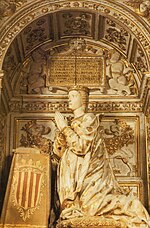
Sepulcher of Elanor of Aragon, in the Cathedral of Toledo.
The Plateresque mode extended from ancestry of the 16th century until the last third of the century and its stylistic influence pervaded the works of all slap-up Spanish artists of the time. Alonso Berruguete (sculptor, painter and architect) is called the "Prince of Spanish sculpture" because of the grandeur, originality, and expressiveness accomplished in his works. His primary works were the upper stalls of the choir of the Cathedral of Toledo, the tomb of Fundamental Tavera in the same Cathedral, and the altarpiece of the Visitation in the church of Santa Úrsula in the same locality.
Other notable sculptors were Bartolomé Ordóñez, Diego de Siloé, Juan de Juni and Damián Forment.

Another menses of Spanish Renaissance sculpture, the Bizarre, encompassed the terminal years of the 16th century and extended into the 17th century until reaching its terminal flowering the 18th, developing a truly Spanish school and manner, of sculpture, more realistic, intimate and independently artistic than that of the previous one which was tied to European trends, especially those of kingdom of the netherlands and Italy. There were ii Schools of special flair and talent: the Seville School, to which Juan Martínez Montañés belonged (called the Sevillian Fidias), whose most celebrated works are the Crucifix in the Cathedral of Seville, another in Vergara, and a Saint John; and the Granada School, to which Alonso Cano belonged, to whom an Immaculate Conception and a Virgin of Rosary, are attributed.
Another notable Andalusian Baroque sculptors were Pedro de Mena, Pedro Roldán and his daughter Luisa Roldán, Juan de Mesa and Pedro Duque Cornejo.
The Valladolid school of the 17th century (Gregorio Fernández, Francisco del Rincón) was succeeded in the 18th century, although with less luminescence, by the Madrid School, and information technology was soon transformed into a purely academic style past the middle of the century. In turn, the Andalusian school was replaced by that of Murcia, epitomised in the person of Francisco Salzillo, during the first one-half of the century. This concluding sculptor is distinguished by the originality, fluidity, and dynamic treatment of his works, fifty-fifty in those representations of great tragedy. More than 1,800 works are attributed to him, the most famous products of his hand being the Holy Week floats (pasos) in Murcia, nearly notable amongst which are those of the Agony in the Garden and the Kiss of Judas.
In the 20th century the most important Castilian sculptors were Julio González, Pablo Gargallo, Eduardo Chillida and Pablo Serrano.
Spanish collectors and museums of art [edit]
The Spanish royal collection was accumulated by Spanish monarchs commencement with Isabel the Catholic, Queen of Castile (1451–1504), who accumulated large and impressive collections of objets d'art, 370 tapastries, and 350 paintings, a number by important artists including Rogier van der Weyden, Hans Memling, Hieronymus Bosch, Juan de Flandes, and Sandro Botticelli.[56] However many of these were dispersed by auction later on her decease in 1504. Isabel'due south grandson, Charles I, the first Habsburg male monarch of Espana, was a patron and collector of art, as was his sister, Mary of Hungary. Both admired works by Titian. When the siblings died, the art passed to Philip II of Kingdom of spain, Charles's son, an fifty-fifty keener collector.[57] Philip Iv (1605–1665) followed in the family tradition as a passionate art collector and patron. During his reign, Velázquez, Zurbarán and others produced many works of fine art. Philip commissioned works and purchased others, sending his representatives to acquire works for the monarch'southward collection. One of Philip Four'southward major contributions to art in Spain was to entail his collection, preventing their sale or other dispersal.[58] Nether the Spanish Bourbon monarch, Charles IV, the notion of bringing together major works from other repositories in Spain took shape, probably non for the public to view but for artists to report.[59] The Prado Museum in Madrid became the principal repository for that art.
The Royal Academy of Fine Arts of San Francisco, founded in 1744, now functions likewise as a museum in Madrid. The Museum of the Americas in Madrid has a collection of casta paintings and other art brought back to Kingdom of spain from the Americas, as well as sculpture and archeological artifacts.
Other artistic disciplines [edit]
- Architecture
- Cinematography
- Music
References [edit]
- ^ some are as former as forty,800 years quondam, co-ordinate to "U-series dating of Paleolithic fine art in xi caves in Spain", Science, 2012 Jun fifteen ;336(6087):1409-thirteen.
- ^ Gudiol, 10-11
- ^ Gudiol, 11-12
- ^ Gudiol, 13-21
- ^ Gudiol, 21-28
- ^ The kickoff R is held at the Musée de Cluny, Paris.
- ^ Gudiol, 29-33
- ^ Gudiol, 59-61
- ^ Gudiol, 34-42, 47-51
- ^ Gudiol, 53-59, 86
- ^ Gudiol, 43-44, 51-52
- ^ Gudiol, 188-197
- ^ Walter Westward. S. Cook, Romanesque Castilian Mural Painting from The Fine art Bulletin, Vol. 11, No.4, Dec 1929, accessed from JSTOR: [i]
- ^ The Prado Guide, pg. 48
- ^ Prado Guide, p. 28
- ^ Prado Guide, p. 42
- ^ Prado Guide, p. 38
- ^ Prado Guide, p. 42
- ^ Prado Guide, p. 42
- ^ The Prado Guide, pg. 48
- ^ Jonathan Brown, The Golden Age of Painting in Spain. New Haven: Yale University Press 1991.
- ^ José Antonio Maravall, Culture of the Baroque: Analysis of a Historical Structure. Minneapolis MN 1986.
- ^ Prado Guide, pg 64
- ^ Prado Guide, pg 74
- ^ Prado Guide, pg 66
- ^ Prado Guide, pg 54
- ^ Prado Guide, pg lx
- ^ Prado Guide, pg 76, 79
- ^ Prado Guide, pg 84
- ^ Prado Guide, pg 84
- ^ Prado Guide, pg 84
- ^ Prado Guide, pg 90
- ^ Jonathan Brown, Velázquez: Painter and Courtier. New Oasis: Yale University Printing 1986.
- ^ Prado Guide, p. 132-139
- ^ Prado Guide, p. 140
- ^ Prado Guide, p. 141
- ^ Prado Guide, p. 147
- ^ Prado Guide, p. 148
- ^ Prado Guide, p. 150–151
- ^ Prado Guide, p. 152–153
- ^ Prado Guide, p. 157
- ^ Prado Guide, p. 154-155
- ^ Prado Guide, pp. 196, 202
- ^ Prado Guide, pp. 196-200
- ^ Prado Guide, p.208
- ^ Prado Guide, p. 210
- ^ Prado Guide, pp. 217
- ^ Haftmann, pg 191
- ^ Haftmann, pg eighty
- ^ From Rubin Dada, Surrealism and Their Heritage pg. 111 (quoted in Gardner, pg. 984)
- ^ Gardiner, pg. 984
- ^ Gardiner pg. 985. 1991
- ^ Gardiner, pg. 985
- ^ Jean-Hubert Martin, foreword of Joan Miró - Snail Adult female Flower Star, pg. 7, Prestel, 2008
- ^ Tate website, quoting: Ronald Alley, Catalogue of the Tate Gallery's Collection of Modernistic Art other than Works by British Artists, Tate Gallery and Sotheby Parke-Bernet, London 1981, pp. 714–15
- ^ Santiago Alcolea Flinch, The Prado. New York: Harry N. Adams, Inc. 1996, p. nine.
- ^ Alcolea Flinch, The Prado, p. 10.
- ^ Alcolea Blanch, The Prado, pp. 10-eleven.
- ^ Alcolea Blanch, The Prado, p. 15.
Farther reading [edit]
- Alcolea Blanch, Santiago. The Prado. Translated from the Spanish by Richard-Lewis Rees and Angela Patricia Hall. New York: Harry Northward. Abrams, Inc. Publishers 1991.
- The Art of medieval Spain, A.D. 500-1200 . New York: The Metropolitan Museum of Art. 1993. ISBN0870996851.
- Berg Sobré, Judith. Behind the Altar Table: The Development of the Painted Retablo in Spain, 1350-1500. Columbia, Miss. 1989.
- Brown, Jonathan, Painting in Spain, 1500-1700 (Pelican History of Art), Yale University Printing, 1998, ISBN 0300064748
- Dodds, Jerrilynn D. (ed.) Al-Andalus: The Fine art of Islamic Espana. New York 1992.
- Gardner's: Art Through The Ages - International Edition, Brace Harcourt Jovanovich, ninth Edn. 1991
- Gudiol, José, The Arts of Spain, 1964, Thames and Hudson
- Jiménez Blanco, María Dolores, ed. The Prado Guide, Madrid: Museo National del Prado, English 2d Revised Edition, 2009
- McDonald, Mark (2012). Renaissance to Goya : prints and drawings from Kingdom of spain. London: The British Museum. ISBN9780714126807.
- Moffitt, John F. The Arts in Spain. London: Thames & Hudson 1999.ISBN 0-500-20315-half-dozen
- O'Neill, John P. (ed.), The Fine art of Medieval Kingdom of spain, AD 500-1200. New York 1993.
- Palol, Pedro and Max Hirmer. Early Medieval Fine art in Spain. New York 1966.
- Sánchez Pérez, Alfonso E. (1992). Jusepe de Ribera, 1591-1652. The Metropolitan Museum of Art. ISBN9780870996474. (full text resource that contains data on Ribera every bit well as a number of other Spanish artists)
- Tomlinson, Janis, From El Greco to Goya: Painting in Spain 1561–1828, Abrams Art History, 1997
- Williams, John. Early Spanish Manuscript Illumination. New York 1977.
- Young, Eric. Bartolomé Bermejo: The Groovy Hispano-Flemish Master. London 1975.
External links [edit]
-
 Media related to Art in Spain at Wikimedia Eatables
Source: https://en.wikipedia.org/wiki/Spanish_art
Belum ada Komentar untuk "Spanish Art Made by the Spanish Drawn or Painted Old"
Posting Komentar