Art Nouveau New Year 2018 in Silver and Black
"Art is a line around your thoughts."
1 of 8

"Color in certain places has the peachy value of making the outlines and structural planes seem more energetic."
"Something impractical cannot be cute."
"I discard the flower and leaf, but continue the stalk."
four of 8

"I believe that everything in Nature aspires to the acme of strength, well-being, and happiness; and everything that deviates from this I call immoral."
"Those who await for the laws of Nature as a support for their new works collaborate with the creator."
"Our roots are in the depths of the woods-on the banks of streams and among the mosses."
"In that location are no straight lines or sharp corners in nature. Therefore, buildings must have no straight lines or abrupt corners."
Summary of Art Nouveau
Generating enthusiasts in the decorative and graphic arts and architecture throughout Europe and beyond, Art Nouveau appeared in a wide diversity of strands, and, consequently, it is known by diverse names, such as the Glasgow Style, or, in the High german-speaking world, Jugendstil. Art Nouveau was aimed at modernizing design, seeking to escape the eclectic historical styles that had previously been popular. Artists drew inspiration from both organic and geometric forms, evolving elegant designs that united flowing, natural forms resembling the stems and blossoms of plants. The emphasis on linear contours took precedence over color, which was usually represented with hues such as muted greens, browns, yellows, and blues. The motility was committed to abolishing the traditional hierarchy of the arts, which viewed the and so-called liberal arts, such as painting and sculpture, as superior to craft-based decorative arts. The way went out of mode for the most part long before the First World War, paving the way for the development of Art Deco in the 1920s, but it experienced a popular revival in the 1960s, and it is now seen equally an important predecessor - if not an integral component - of modernism.
Key Ideas & Accomplishments
- The desire to abandon the historical styles of the 19th century was an important impetus behind Fine art Nouveau and one that establishes the movement'south modernism. Industrial production was, at that point, widespread, and yet the decorative arts were increasingly dominated by poorly-fabricated objects imitating earlier periods. The practitioners of Fine art Nouveau sought to revive adept workmanship, raise the status of craft, and produce genuinely modern design that reflected the utility of the items they were creating.
- The academic organization, which dominated art teaching from the 17th to the 19th century, underpinned the widespread belief that media such as painting and sculpture were superior to crafts such as furniture design and ironwork. The consequence, many believed, was the neglect of good craftsmanship. Art Nouveau artists sought to overturn that belief, aspiring instead to "total works of the arts," the famous Gesamtkunstwerk, that inspired buildings and interiors in which every element worked harmoniously inside a related visual vocabulary. In the process, Art Nouveau helped to narrow the gap between the fine and the applied arts, though it is debatable whether this gap has ever been completely closed.
- Many Art Nouveau practitioners felt that earlier blueprint had been excessively ornamental, and in wishing to avoid what they perceived every bit frivolous decoration, they evolved a belief that the function of an object should dictate its form. In do this was a somewhat flexible ethos, yet it would be an of import role of the manner's legacy to after modernist movements, nigh famously the Bauhaus.
Overview of Fine art Nouveau
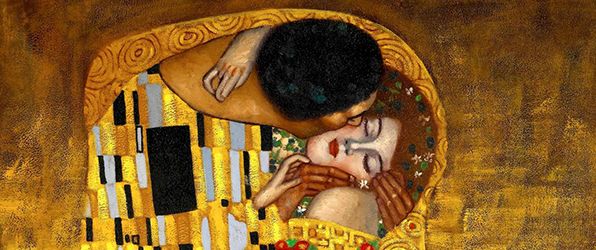
Gustav Klimt famously said, "Plenty of censorship…I refuse every course of back up from the state, I'll exercise without all of it," – because he was attacked for his piece of work'southward swirling erotic forms, he went on pioneer his Golden Period – ane of the highlights of Fine art Nouveau.
Central Artists
-

Austrian painter Gustav Klimt was the almost renowned advocator of Art Nouveau in Vienna, and is remembered as one of the greatest decorative painters of the twentieth century. He also produced one of the century's well-nigh significant bodies of erotic art.
-

Guimard was a leading figure in the Fine art Nouveau movement and the buildings that he designed exemplified the aims of the movement with their organic curves, unity of decorative arts, and natural elements. He made his greatest mark in Paris where in 1900 he designed the entrances to most of the city's metro stations.
-

Synonymous with Art Nouveau, Horta was one of the greatest innovators and pioneers of the move, designing flamboyant, lush, and organic houses, buildings, and offices. His works are marked by their curvilinear botanic forms, nigh of which tin can still be seen in the urban center of Brussels.
-

Mackintosh was a Scottish architect, designer, sculptor and decorative artistwho is all-time known equally the United Kingdom's greatest proponent of Art Nouveau and founder of the Glasgow Style.
-

Aubrey Beardsley was a nineteenth-century English illustrator and author. In black ink he created highly erotic, grotesque, and decadant drawings, much in the style of Japanese woodcuts. Beardsley'due south work was part of the Aesthetic motion, and was highly influential to the subsequent Fine art Nouveau movement of the early-twentieth century.
-

Alphonse Mucha was a Czech painter, designer and illustrator usually associated with the Art Nouveau motion. Although largely forgotten in the annals of decorative art, Mucha is perhaps all-time known for his outspoken Slavic nationalism, which greatly informed his work. In particular, Mucha's The Slav Epic, a series of twenty big paintings depicting the history of Czech and Slav peoples, survives as the artist'southward greatest masterpiece.
-

Antoni Gaudí was the virtually popular representative of the Catalan Modernista motion, which combined elements of Art Nouveau, Japonisme, Gothic design, and geometric forms. Gaudi'due south pattern style has been referred to equally "global," indicating a profound attention to every item of his work, from a building'southward structure and placement downwardly to its smallest decorative details. Gaudi'south masterpiece is the Sagrada Familia, a distinctly modern church in Barcelona.
-

Louis Comfort Tiffany was an American glass designer, painter and decorative creative person, and undoubtedly the American about associated with the Fine art Nouveau motility.


Do Non Miss
-

Rising to prominence in Germany in the late nineteenth century, Jugendstil, which means "youth style" in German, influenced the visual arts (particularly graphic design and typography), decorative arts, and architecture.
-

The Vienna Secession was a grouping of Austrian painters, sculptors and architects, who in 1897 resigned from the main Association of Austrian Artists with the mission of bringing mod European art to culturally-insulated Austria. Amid the Secession's founding members were Gustav Klimt, Koloman Moser, Josef Hoffmann and Joseph Maria Olbrich.
-

Art Deco was an eclectic mode that flourished in the 1920s and '30s and influenced fine art, architecture and design. Information technology blended a honey of modernity - expressed through geometric shapes and streamlined forms - with references to the classical by and to exotic locations.
-

The Wiener Werkstätte was an early-twentieth-century product company of artists, founded in Vienna in 1903, by builder Josef Hoffmann. It adult largely in response to the Vienna Secession, inspiring others to found a company that catered to artists working in all diverseness of media, from jewelry and ceramics to metalworks and furniture making. The Wiener Werkstätte was quite successful, opening branches into Karlsbad, Zurich, Berlin and New York, but eventually had to shut down due to financial constraints.


Of import Fine art and Artists of Art Nouveau

Cover design for Wren's City Churches (1883)
Mackmurdo'due south woodcut is an instance of the influence of English language design, specially the Arts and Crafts movement, on Fine art Nouveau. The woodcut as a genre points to the handcrafted, unique quality of the work and the simplicity of Mackmurdo'due south use of positive and negative space both contribute to this clan. Meanwhile, Mackmurdo'south abstruse-cum-naturalistic forms and the trademark whiplash curves are characteristic of the visual sense of free move and energy that would eventually define Art Nouveau. The emphasis on the floral and vegetal imagery adorning the encompass which refuses any real consonance with the professed subject field matter of the book besides highlights its purposefully decorative quality, hinting at how Mackmurdo's work is of an experimental nature rather than a definitive, mature example of Fine art Nouveau. The woodcut proves far more valuable than the actual content, which consists of a rambling, loose description of the architecture of the Baroque London churches designed by Sir Christopher Wren.

La Goulue at the Moulin Rouge (1891)
Toulouse-Lautrec is one of Art Nouveau'south most important graphic artists who were responsible for raising the poster from the realm of advertising ephemera to high art during the 1890s (the same decade that saw the establishment of artistic magazines solely defended to this medium). Lautrec and his fellow graphic artists understood that they were innovative, though the stylistic characterization "Art Nouveau" was probably never practical to them until after Lautrec's death in 1901.
La Goulue at the Moulin Rouge takes the flourish and messiness of a French tin can-can dancer's clothes and breaks information technology down to a few simple, rhythmic lines, thereby suggesting the sense of motility and space. The flattening of forms to mere outlines with the flat infill of color recalls Fine art Nouveau'due south debt to Japanese prints also as the lighting in such nightclubs that naturally would render the surface details of figures and other objects indistinct. Likewise, the repetitive red lettering of the cabaret's proper name suggests the pulsating energy of the performances for which dancers like La Goulue (stage proper noun of Louise Weber, one of Lautrec's friends) took heart stage.

The Peacock Brim (1894)
Beardsley's The Peacock Skirt is an illustration made for Oscar Wilde's 1892 play Salome, based on the Biblical narrative centered on Salome's order to behead and serve on a platter the head of John the Baptist. (Salome was a pop bailiwick for many other Art Nouveau artists, including Victor Prouvé.) Beardsley'southward Salome is comparatively tame in comparison with some of the illustrator'south more erotic and nigh pornographic works. Information technology is a fine case of how many artists influenced by Art Nouveau laid corking emphasis on line, often abstracting their figures to produce the stylish sinuous curves so feature of the manner. Ane might as well take it every bit an example of how the formal vocabulary of the manner could exist used with exuberant excess, a quality that would later concenter criticism. The influence of Japonese prints on Fine art Nouveau is as well evident in Beardsley's work in its flattened rendition of form. Merely this illustration might also be taken as an instance of the contemporaneous Aesthetic movement, and in that respect it demonstrates how Fine art Nouveau overlapped and interacted with diverse other period styles.
Useful Resources on Art Nouveau
Content compiled and written past Justin Wolf
Edited and revised, with Summary and Accomplishments added by Peter Clericuzio
"Fine art Nouveau Movement Overview and Analysis". [Net]. . TheArtStory.org
Content compiled and written past Justin Wolf
Edited and revised, with Summary and Accomplishments added by Peter Clericuzio
Available from:
First published on 21 Jan 2012. Updated and modified regularly
[Accessed ]
Source: https://www.theartstory.org/movement/art-nouveau/
Belum ada Komentar untuk "Art Nouveau New Year 2018 in Silver and Black"
Posting Komentar