To Convert a Volume Measurement to a Weight Measurement
When it comes to baking, accuracy in your measurements is critical to a recipe'south success, and the single most authentic style to mensurate your ingredients is by weight.
I've received a few questions lately on some of my more than popular cake recipes that seem to imply some defoliation about weight versus volume measurements, specifically when it comes to measuring dry out ingredients like flour. I figured I'd exercise a fleck more than in-depth explanation in a post, to hopefully clear upward whatsoever confusion.
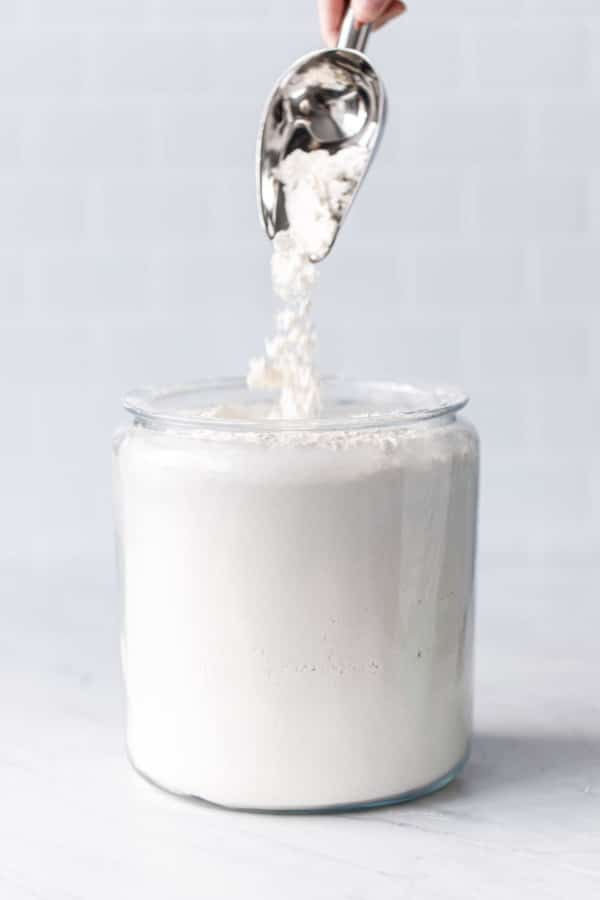
American bakers grew up using cups, where a cup of water is equal to a loving cup of flour and and so along. We likewise had it drilled into our brains that a cup is viii ounces and a pint is a pound the earth round (a pint being two cups or xvi fluid ounces).
But I'g here to say that a pint is Non e'er a pound and a cup is NOT e'er 8 ounces—it depends on what you're measuring.
Now before you starting time arguing, allow me explicate!
Weight versus Volume
Book is a measure of the amount of space something takes up. Things like cups of flour, gallons of milk, cubic anxiety of helium… these are all volume measurements.
Weight is a measurement of an object'south heaviness. Grams of salt, pounds of carbohydrate, kilograms of apples… these are measurements of weight.
Ok. So, that makes sense, right? Volume and weight are measuring ii entirely different things.
You lot've heard the old riddle: Which weighs more: a pound of feathers or a pound of pb?
Fox question: they both weigh a pound! Merely the lead is going to have a much smaller book since it is more dumbo than the feathers, so it will wait like a smaller amount of material.
When we're talking about blistering, the differences might not be quite equally credible equally feathers and lead, but the same is truthful of flour and water: one is much less dense than the other (in this instance the flour is the feathers and the h2o is the lead). So a pound of flour is going to take up more space, or volume, than an equivalent pound of water.
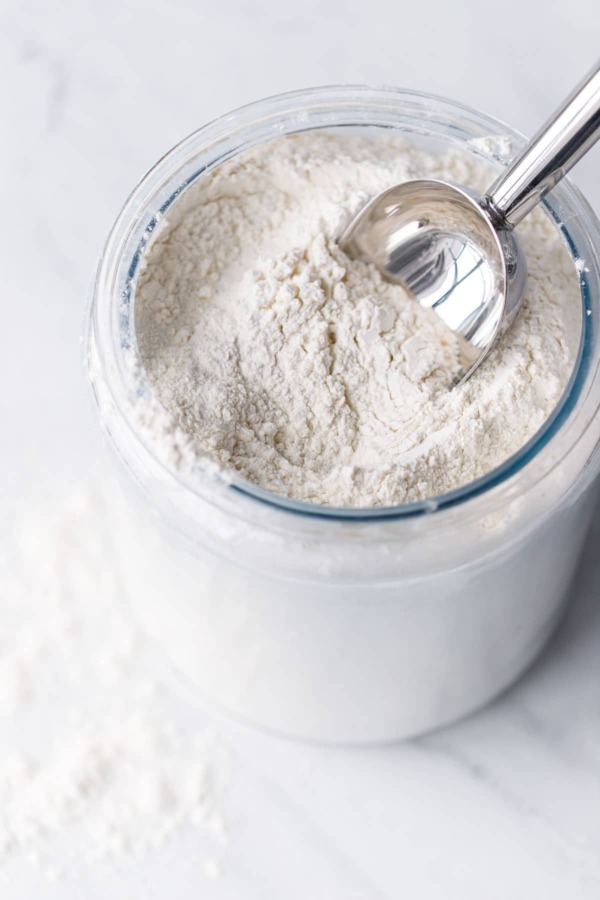
An Ounce of Confusion
Virtually of the confusion regarding weight and volume measurements occurs when talking about ounces: an royal unit of measurement which can exist used to betoken both weight AND volume. Fluid ounces refers to volume (similar milliliters) whereas regular ounces refer to weight (like grams). The fact that they are both called ounces, and not ever differentiated past proverb ounce/fluid ounce is one reason why they are so problematic.
Ounces past weight and ounces past volume are Only comparable when you are measuring h2o or other liquids with a similar density.
For example, eight ounces of water by weight volition equal 8 fluid ounces by volume.
Flour, on the other hand, is a totally different abortion and a disruptive one to boot. Not that y'all'd ever measure flour with fluid ounces (which are only designed to measure—you guessed it—fluids), merely, if you did, yous'd find that 8 fluid ounces of flour only weighs almost four one/4 ounces. Counterbalance out 8 ounces of flour past weight and you lot're going to have near 14 fluid ounces past volume. See how disruptive it is?
I mean, who exercise we need to petition to have fluid ounces inverse to exist called something totally different (flounces? frams? vols?) or, better even so, finally but switch to metric like the rest of the world?
Anyway.
Here are some visual comparisons to help illustrate this concept (proceed in mind that you shouldn't exist measuring flour in a liquid measuring cup like this, I but did then hither then I could illustrate the differences between ounces by weight and ounces by volume).
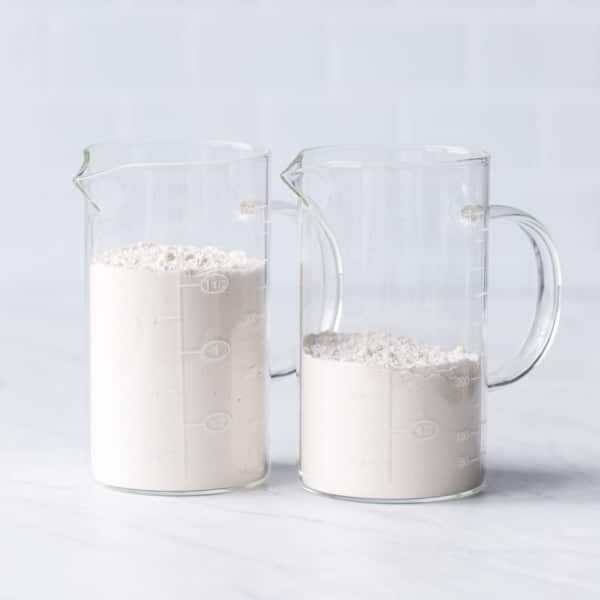
Both of these containers are holding 8 ounces.
On the left is viii ounces of flour by weight, and on the right is eight ounces of flour by volume (aka 1 loving cup).
If you weighed the 2 containers, the one on the right would but weigh approximately four i/four ounces.
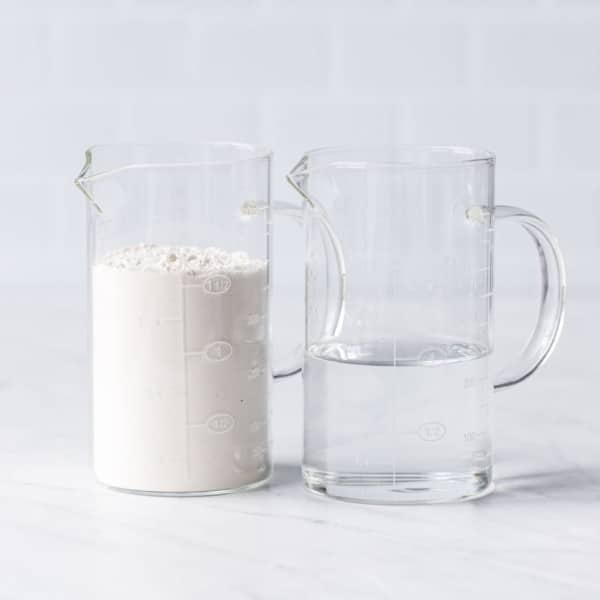
Both of these containers are holding eight ounces.
Weigh out 8 ounces of flour and eight ounces of water on a scale and this is what you get. Visually it looks similar you have a lot more flour than water, only they weigh the verbal same corporeality.
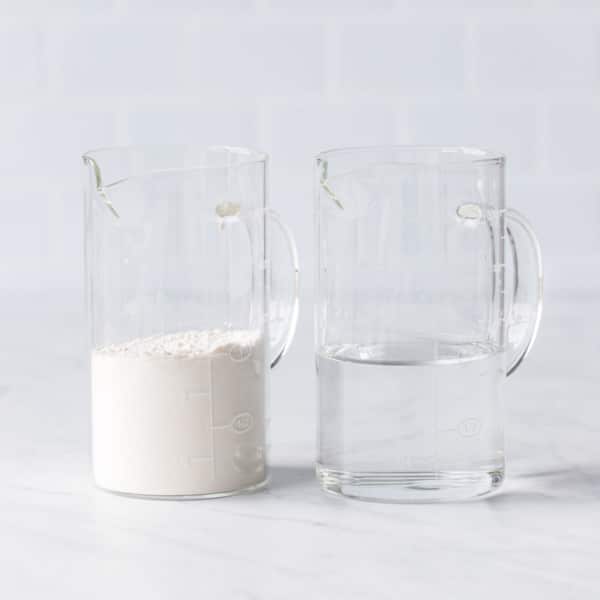
Both of these containers are belongings viii ounces.
On the left is 8 ounces of flour by volume and on the right is 8 ounces of h2o by volume. Basically, what you run across here is i cup of flour and one cup of water.
But if you put these 2 containers on a scale, the flour on the left would only weigh 4 1/4 ounces, while the h2o would counterbalance 8 ounces.
And then, are you lot less confused yet? More than confused? I don't blame you (lol).
My advice? When you lot're baking, forget ounces entirely. Pretend they don't even exist. It merely confuses things. Instead, focus on cup/tablespoon measurements for volume, and grams for weight.
I'one thousand trying to be ameliorate about writing my recipes using just cups and grams for this very reason, though you may even so encounter ounces on older recipes or for things that are sold by the ounce, like bars of chocolate or cans of pumpkin.
Tip: When purchasing packaged or canned goods, if yous're unsure whether the ounce measurement on the package refers to ounces by weight or fluid ounces, await at the metric equivalent. If it'due south grams (like on canned pumpkin or chocolate bars), you're dealing with weight. If information technology'due south liters (similar on milk or wine) and then you're dealing with fluid ounces.
The Beauty of Metric
One of the beautiful things about the metric system is that there is no confusion. Grams are weight, milliliters are volume. If you come across grams, catch your scale. If you see milliliters, catch your liquid measuring cup.
Another genius aspect of the metric system is that it is calibrated to water: so when you're measuring h2o or other liquids with a like density (similar milk or orange juice), 200 milliliters will weigh 200 grams. Cool!
Even so, once y'all get-go measuring dry ingredients, which often have varying densities, the two numbers will non match.
1 cup of water weighs 236 grams.
1 cup of flour weighs 125 grams.
The volume is the same, but the weight is different (remember: lead and feathers).
Ane other benefit to using metric measurements is accuracy: scales often only show ounces to the quarter or eighth of an ounce, so four one/four ounces or 10 1/8 ounces. Grams on the other mitt, being a much smaller unit of measurement, make it easier to exist incredibly precise. Exactly 236 grams of water is a much more accurate measurement than 8 3/8 ounces (technically 236 grams equals eight.32466 ounces only you're not going to be able to measure out that on a calibration). The difference of 1/8th of an ounce is three-4 grams, which may not seem like much, but it tin can add upwards.
A cup is a cup is a cup
… depending on what you're measuring and how you measure it.
Liquids are pretty reliable. A loving cup is pretty much always going to be a cup.
But for dry ingredients, flour specifically, the small granules of flour can exist compacted, essentially packing more than flour into the same amount of space (think nearly packing brown saccharide, it'due south a similar idea).
So depending on how you measure your flour, if you lot fluff it and spoon information technology into the cup, or if yous scoop directly from a bag of flour that has settled, your 'loving cup' may vary by as much equally 30% by weight, from 120 grams to upwardly of 150 grams (!!) When you're making a cake that calls for three cups of flour, that'due south almost an entire extra loving cup if yous're scooping direct from the handbag. No wonder the cake is likewise dry…
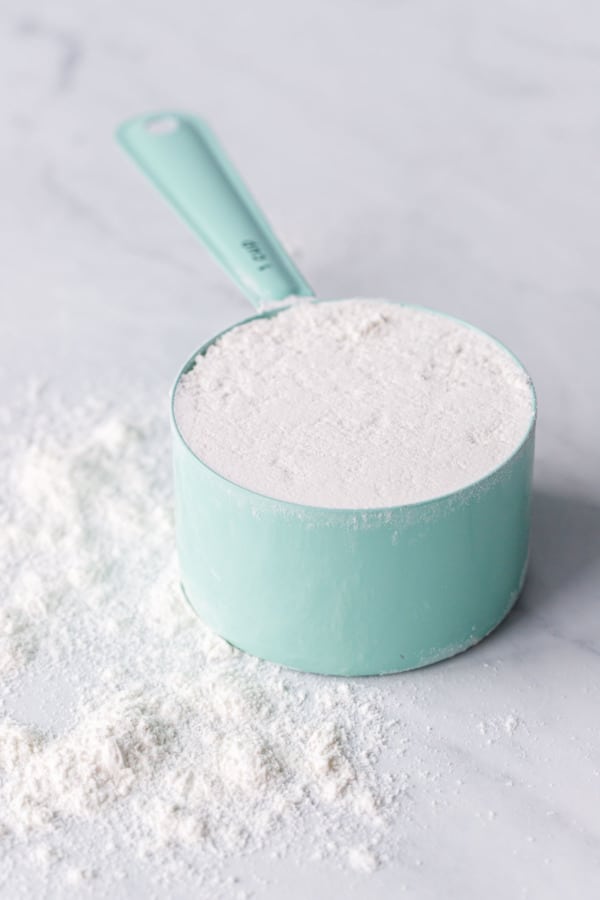
Here you can see what I mean. The cup on the left was measured using the fluff, spoon and sweep method, while the one on the right was scooped right out of the handbag. 125 grams and 146 grams may non seem like a big difference, but it can mean the departure between a perfectly moist chocolate cake and a dry out 1.
The best mode to measure out flour is…
With a scale! In grams! (If you've read this far you probably guessed that.)
However, I know that'southward not ever going to happen. We're so used to baking with cups that getting out the scale feels like a job. And, while I've acclimated myself to using mainly weight-based measurements, I acknowledge that it is not for anybody.
If you lot're going to continue to use cups, it'southward helpful to know the best method for measuring a perfect cup of flour: ane that's actually a true cup and not a compacted 1.
My favorite method: fluff, spoon and sweep.
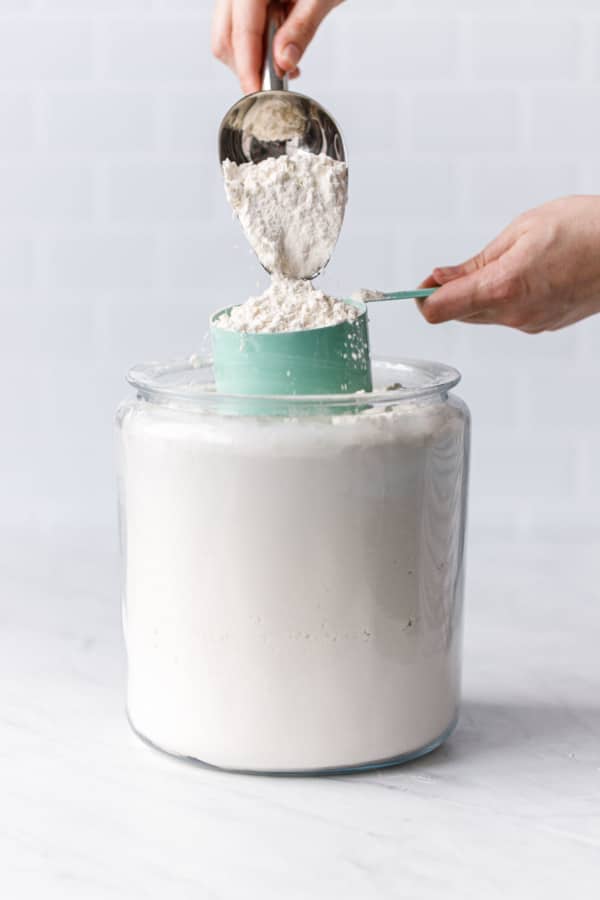
Offset, fluff upward your flour by stirring it in the bag (or, better however, pour it out of the pocketbook into a large canister which will do a smashing chore of aerating on its own).
And then, spoon flour and sprinkle information technology into your measuring loving cup. Don't scoop flour directly into the measuring cup, which can compact it. Rather, get a big spoonful of flour and sprinkle it into the measuring loving cup.
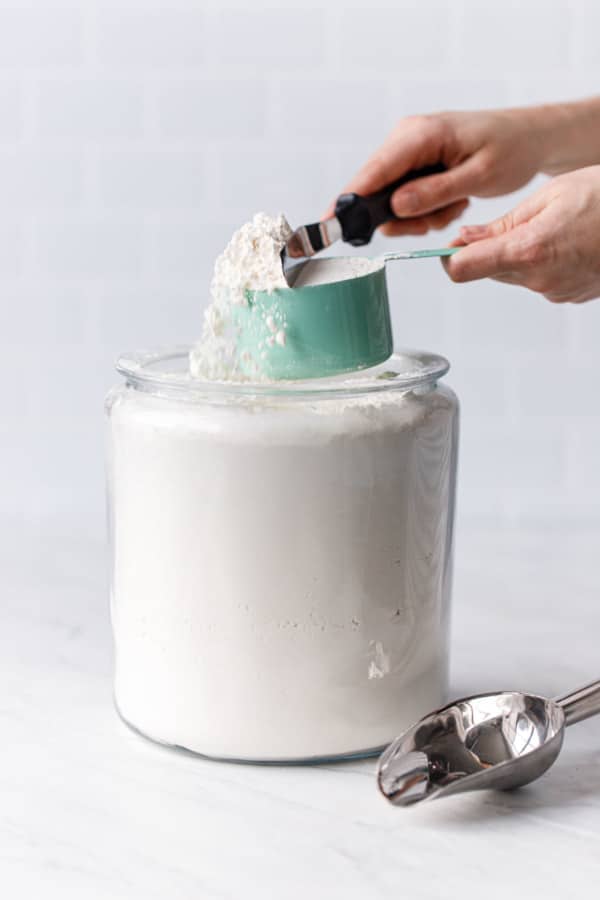
Once you lot've got a heaping pile of flour in the measuring cup, sweep off the excess using a straight-edge like the back of a butter pocketknife or offset spatula to level off the top of the cup.
Try this out a few times with a calibration handy, and encounter what weight you go for 1 loving cup of flour. Yous should run into about 125 grams of flour per level loving cup. If you are getting 130 grams or higher, you lot might want to revisit your method (possibly you're non fluffing it plenty, or maybe you are compacting the flour when you level information technology, or perhaps your measuring cups are off.)
Now only for comparison, get scoop a big cup of flour right out of a pocketbook. Actually dig your loving cup in there. Level off the top, and then counterbalance the flour. Detect a divergence? I bet y'all will! Those actress xxx or more grams of flour tin can really make a departure when blistering, as actress flour tin can lead to dry or dumbo cakes and cookies.
Cocoa pulverisation is another ingredient that can be compacted, then using either weight or the fluff, scoop and sweep method is useful here likewise.
Liquid versus Dry Measuring Cups
Unless you only bake with weight-based measurements exclusively, you should accept ii kinds of measuring cups in your kitchen: liquid measuring cups and dry measuring cups, and you should utilize each accordingly. Don't cascade liquids into dry out measuring cups, and likewise don't effort to mensurate flour in a liquid measuring cup. But put, you're non going to get authentic results.
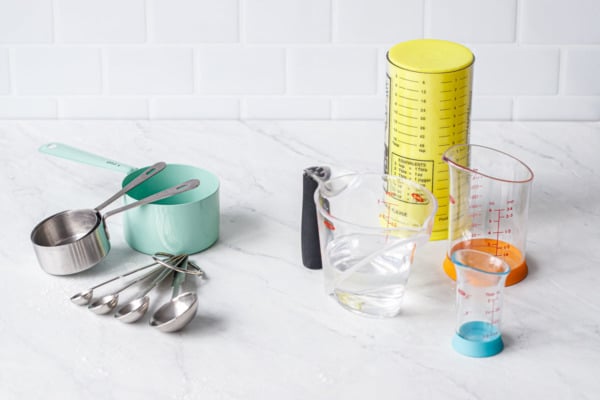
Liquid measuring cups are articulate, with marks on the side of the cup indicating the book of liquid in cups, ounces and milliliters. The ounce markers here refer to fluid ounces, and for water-like liquids the ounces by weight will equal the ounces by book. However for liquids of different densities, say, sweetened condensed milk, for example, 1 loving cup or 8 fluid ounces will actually counterbalance 10 ounces on a scale.
Dry out measuring cups and spoons should be labeled with only the dry volume quantity, such as ane/2 cup or 1 tablespoon. If you lot find yourself with a set of dry measuring cups that also lists grams or ounces on them, either teach yourself to ignore those numbers entirely (they're only relevant for liquids, which you shouldn't be measuring with dry cups anyway)… or buy a new prepare of measuring cups altogether.
Why can't you measure out dry out ingredients in liquid measuring cups? Well, it's difficult to go them level. If yous spoon some flour into a liquid measuring cup, the top is going to be uneven. So maybe you milkshake information technology a bit to try to level out the pinnacle, simply you're really just compacting the flour even more. With a dry measuring loving cup, you tin perfectly level off the superlative using a pocketknife or other direct edge, making sure you accept exactly the corporeality you need.
Why can't you measure wet ingredients in dry measuring cups? Well, you can, sort of, but you'll probably brand a mess of it. Considering to get a proper measurement y'all accept to fill the cup total to the brim with the liquid. Good luck trying to move it to your bowl without spilling…
Technically even liquids similar vanilla extract should be measured in a liquid measurer, although for such pocket-size amounts similar this it is not disquisitional (it's reasonably like shooting fish in a barrel to measure out ane teaspoon of vanilla in a spoon without spilling it). I like this beaker measuring prepare for that reason.
Liquids aren't quite as problematic as dry ingredients, equally you tin can't 'compact' the molecules of, say, milk the way you lot can with flour. So a cup of milk is going to exist pretty consistent in terms of book and weight. But remember that the ounces printed on your liquid measuring cups are fluid ounces, which aren't always equal to ounces by weight.
Tip: Weigh your empty mixing basin and write that number on the bottom of the bowl with a sharpie. And so y'all know the tare weight of the bowl even if y'all forget to tare your scale before adding ingredients.
Simply the gold standard of measurement regardless of what yous're measuring is to weigh out everything with a kitchen scale in grams. You simply cannot measure weight with volume-based measuring cups. Measuring by weight ways you don't accept to bargain with measuring cups at all (hooray for fewer dishes!)
Mutual Ingredient Weights
- All Purpose Flour: 1 cup = 125 grams
- Cocoa Powder: 1 cup = 120 grams
- Sugar: 1 cup = 200 grams
- Brown Sugar: ane cup = 220 grams
- Butter: 1 cup = 226 grams
- Water: 1 cup = 236 mL/236 grams
- Milk/Cream: = 240 mL/240 grams
The more you bake by weight, you'll start to memorize these common conversions until yous no longer have to look them up!
I'd advise picking up a copy of The Bakery's Appendix which has listings of dozens of common ingredients and their equivalent weights (I use these values equally reference points when writing recipes). You lot can also use a resource similar King Arthur Flour's Main Weight Chart also (impress out a copy, laminate it and stash it backside your flour canisters).
Do notation that different sources do list different base of operations weights, for example King Arthur lists 1 cup of flour at 120 grams and The Baker's Appendix says 125 grams.
When in doubt, follow the recipe!
There may be chapter links in this post. We are a participant in the Amazon Services LLC Assembly Program, an chapter advertisement programme designed to provide a ways for the states to earn fees past linking to Amazon.com and affiliated sites.
Source: https://www.loveandoliveoil.com/2020/01/weight-vs-volume-measurements-in-baking-and-the-best-way-to-measure-flour.html
Belum ada Komentar untuk "To Convert a Volume Measurement to a Weight Measurement"
Posting Komentar