“Economic growth will always lead to inflation.†To what extent is this a true premise?
Overview
The outlook for euro area activity and aggrandizement has become very uncertain and depends crucially on how the Russian war in Ukraine unfolds, on the impact of current sanctions and on possible further measures. [1] The baseline includes an initial assessment of the impact of the war on the euro expanse economy based on the data bachelor up to 2 March 2022. Soaring energy prices and negative confidence furnishings imply significant headwinds to domestic demand in the near term, while the announced sanctions and sharp deterioration in the prospects for the Russian economy will weaken euro area trade growth. The baseline projections are built on the assumptions that current disruptions to free energy supplies and negative impacts on confidence linked to the conflict are temporary and that global supply bondage are not significantly afflicted. Based on these assumptions, the baseline projections foresee a significant negative impact on euro area growth in 2022, from the conflict. Nevertheless, given the starting point for the euro expanse economy, with a strong labour market and headwinds related to the pandemic and supply bottlenecks assumed to fade, economic activity is still projected to expand at a relatively potent pace in the coming quarters. Over the medium term, growth is projected to converge towards historical average rates, despite a less supportive financial stance and an increment in interest rates in line with the technical assumptions based on financial market expectations. Overall, real Gdp growth is projected to average 3.7% in 2022, ii.8% in 2023 and 1.six% in 2024. Compared with the December 2021 Eurosystem staff projections, the outlook for growth has been revised down by 0.5 pct points for 2022 attributable mainly to the bear upon of the Ukraine crisis on energy prices, confidence and trade. This downward revision is partly starting time by a positive behave-over effect from upwards data revisions for 2021. Growth in 2023 has been revised down by 0.one pct points, while in 2024 it is unchanged.
Following a series of exceptional energy toll shocks, the conflict in Ukraine implies that headline inflation in the baseline is projected to remain at very loftier levels in the coming months, before easing slowly towards target. It is set to boilerplate 5.i% in 2022, 2.1% in 2023 and one.9% in 2024. Near-term price pressures have risen significantly, in item those related to oil and gas bolt. These pressures are assessed to be more lasting than previously expected and to be only partly outset by dampening effects on growth from lower confidence and by weaker trade growth related to the conflict. Nevertheless, in the absence of further upward shocks to commodity prices, energy inflation is projected to drop significantly over the projection horizon. In the brusque term, this decline relates to base of operations furnishings, while the technical assumptions based on futures prices embed a pass up in oil and wholesale gas prices resulting in a negligible contribution from the energy component to headline aggrandizement in 2024. HICP inflation excluding energy and food remains high in 2022, at 2.6%, reflecting stronger price dynamics for contact-intensive services, indirect furnishings from higher energy prices and upward impacts from ongoing supply bottlenecks. As these pressures ease, this measure out of underlying aggrandizement is expected to subtract to one.eight% in 2023 so to ascent to 1.nine% in 2024, on account of strengthening demand, tightening labour markets and some second-round effects on wages, in line with historical regularities. Compared with the Dec 2021 Eurosystem staff projections, in cumulative terms over the projection horizon, headline aggrandizement has been revised up substantially, specially in 2022. This upward revision reflects recent data surprises, higher free energy commodity prices, more persistent upward pressures from supply disruptions and stronger wage growth, also related to the planned increase in the minimum wage in Federal republic of germany. The up revision besides takes into account the recent render of survey-based indicators of medium-term aggrandizement expectations to levels consequent with the ECB'south inflation target. These furnishings more than starting time the negative bear on on inflation of a pregnant upwardly revision to the market-based assumptions on interest rates and the negative demand-related effects of the conflict in Ukraine.
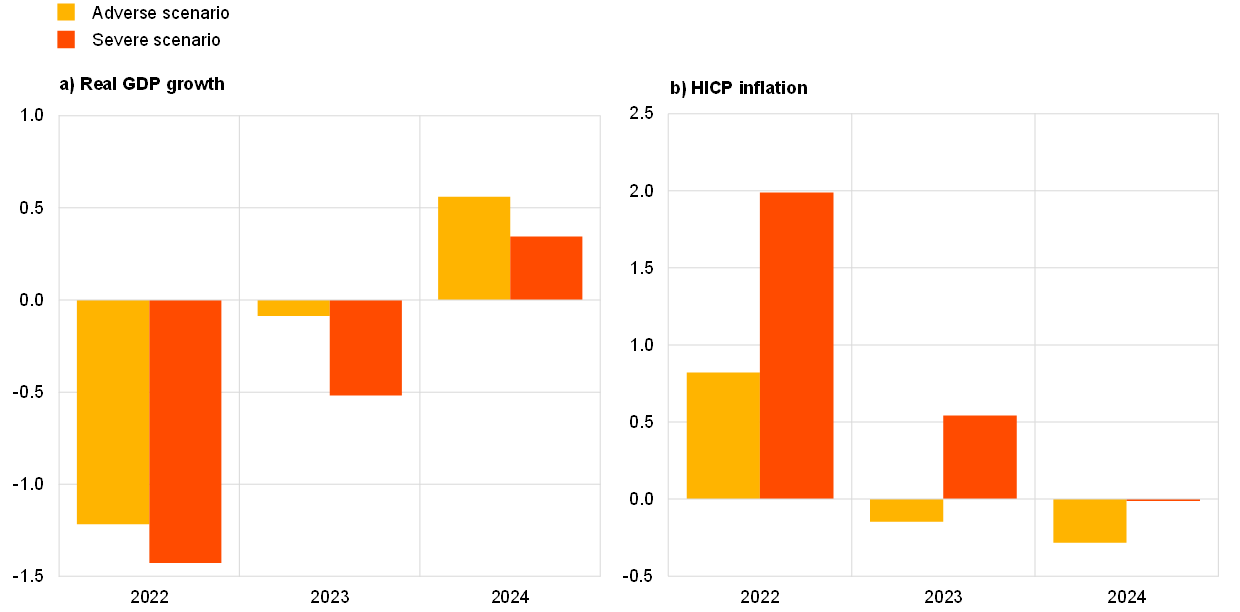
On account of the significant uncertainty surrounding the impact of the disharmonize in Ukraine on the euro surface area economic system, in addition to the baseline, ii scenarios have been prepared. Compared with the baseline, an "adverse" scenario assumes that stricter sanctions are imposed on Russia, leading to some disruptions in global value chains. Persistent cuts in Russian gas supplies would lead to higher energy costs and to cuts in euro surface area production, but this would exist simply temporary as substitution into other energy sources takes place. In addition, geopolitical tensions would be more sustained than in the baseline, leading to boosted fiscal disruptions and more persistent uncertainty. Under such a scenario, euro expanse Gdp growth would exist one.2 percentage points lower than the baseline in 2022, while inflation would be 0.eight percentage points college. Differences would be more express in 2023. In 2024, growth would exist somewhat stronger than the baseline equally the economic system catches upwards later the larger negative touch on economic activity in 2022 and 2023. As oil and gas markets rebalance, the large spikes in free energy prices would gradually unwind, causing inflation to decline below the baseline, peculiarly in 2024. A more than "severe" scenario includes, in addition to the features of the adverse scenario, a stronger reaction of energy prices to more stringent cuts in supply, stronger repricing in financial markets and larger second-round effects from ascension energy prices. This scenario would imply GDP growth in 2022 that is 1.4 per centum points below the baseline, while inflation would be 2.0 percentage points college. Significantly lower growth and higher inflation, compared with the baseline, would also be seen in 2023. Higher persistence of the disruptions triggered past the war imply that, in 2024, the catch-up furnishings on growth would exist relatively modest whereas stronger second-round effects would commencement the negative impact on inflation from failing energy prices.
Growth and inflation projections for the euro surface area
(annual per centum changes)

Notes: Real GDP figures refer to seasonally and working day-adapted data. Historical data may differ from the latest Eurostat publications due to data releases afterward the cutting-off date for the projections.
1 Existent economy
Existent Gross domestic product growth moderated to 0.3% in the 4th quarter of 2021 amidst tightening supply bottlenecks, more stringent pandemic restrictions and higher energy prices, broadly in line with expectations in the December 2021 projections. Individual consumption contracted equally a issue of rise infection rates and renewed pandemic uncertainty, coupled with a toll-induced drop in existent disposable income. In dissimilarity, investment and public consumption provided positive contributions to growth, and economic activity returned to its pre-pandemic level.
Nautical chart 1
Euro area existent GDP growth
(quarter-on-quarter per centum changes, seasonally and working 24-hour interval-adjusted quarterly data)

Notes: Data are seasonally and working day-adjusted. Historical data may differ from the latest Eurostat publications due to data releases after the cutting-off date for the projections. The vertical line indicates the start of the project horizon.
Real Gdp growth is expected to remain subdued in the first quarter of 2022 amongst tighter mobility restrictions, persistent supply disruptions, high energy prices and the conflict in Ukraine (Chart 1). A drop in retail sales in December 2021 (downwards 2.seven% from November) and a contraction in contact-intensive services due to tighter mobility restrictions at the plough of yr translated into a negative conduct-over consequence for growth in the commencement quarter of 2022. This effect appears to have been partially compensated by a marginal monthly increment of retail sales in January 2022 (0.two%). More forward-looking indicators, such as the blended output Purchasing Managers' Index (PMI) and the European Commission'southward Economic Sentiment Indicator, broadly remained in January and February at levels seen in the fourth quarter. Despite an improvement in the PMI for manufacturing supplier commitment times in Jan and February, the alphabetize continues to bespeak intense supply disruptions. Nevertheless, the surveys on which these indicators are based were conducted before the outbreak of the conflict in Ukraine. Taking the further free energy shock and the dubiousness acquired by the Russian invasion of Ukraine as well into account, existent GDP growth for the first quarter of 2022 has been revised down by 0.two percentage points compared to the December projections, and is now expected to be 0.2%.
The outlook for euro area action has become very uncertain and crucially dependant on events in Ukraine. The war in Ukraine is weakening the near-term growth outlook mainly via merchandise, article prices and confidence channels. Sanctions and the economic elevate on the Russian economy are weighing on euro area foreign demand, even though direct merchandise linkages with Russia are express. Soaring free energy prices and negative conviction effects, coupled with a deterioration in risk sentiment and declines in stock prices, imply subdued domestic need. Nonetheless, our baseline projections presume that any disruption to energy supplies related to the disharmonize volition be temporary and accept no meaning lasting impact on economic activity in the euro area. Box 3 provides more detail on the bear upon that the disharmonize is expected to have on the euro area economic system and describes two culling scenarios based on more negative assumptions.
Economical growth is nevertheless projected to pick upwards from the second quarter of 2022 equally a number of headwinds start to fade, just this increase is tempered by the negative effects of the conflict in Ukraine. The expected improvement beyond the near term is based on a number of supporting factors: a diminishing economic affect from the pandemic, a gradual unwinding of supply bottlenecks and an improvement in export price competitiveness vis-à-vis key trading partners. In contrast, the conflict in Ukraine is expected to negatively affect euro surface area growth. Although the Next Generation EU (NGEU) programme is expected to boost investment in some countries, the withdrawal of temporary regime support measures implies that fiscal policy is expected to exist less supportive, especially in 2022. Despite the increase in interest rates embedded in the technical assumptions, financing conditions will keep to be favourable. Overall, despite the downgraded outlook in the curt term, real Gdp is foreseen to broadly return to the path expected in the pre-pandemic projections (Nautical chart ii).
Chart 2
Euro area real GDP
(chain-linked volumes, Q4 2019 = 100)
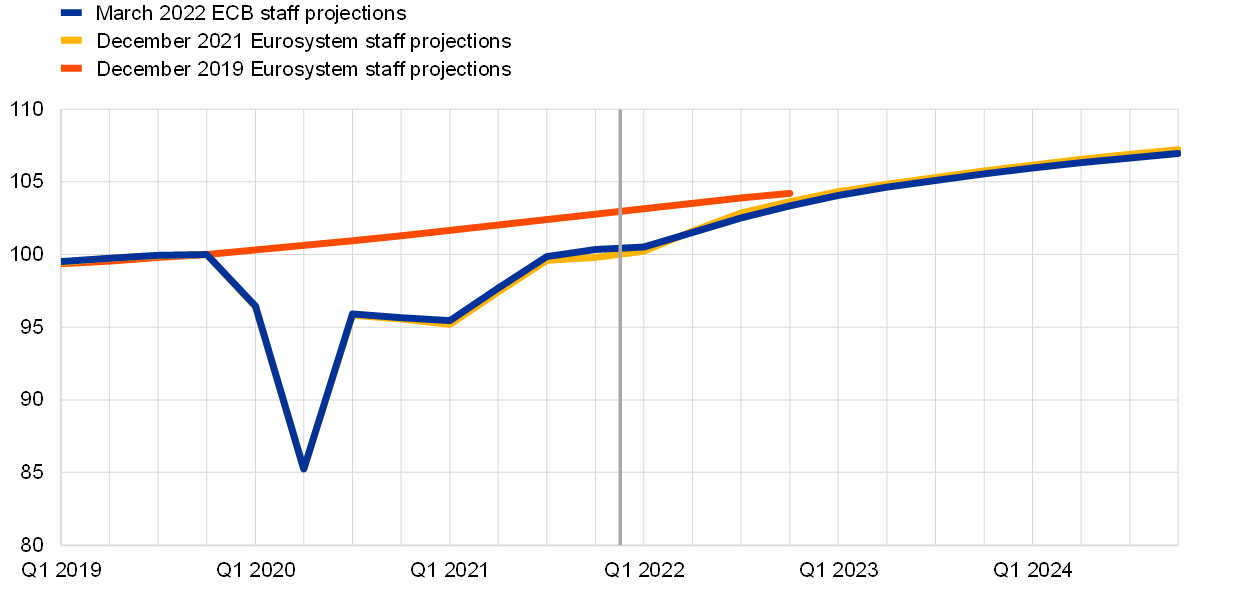
Notes: Information are seasonally and working day-adapted. Historical data may differ from the latest Eurostat publications due to data releases afterward the cut-off engagement for the projections. The vertical line indicates the start of the current projection horizon.
Table 1
Macroeconomic projections for the euro expanse
(annual pct changes)
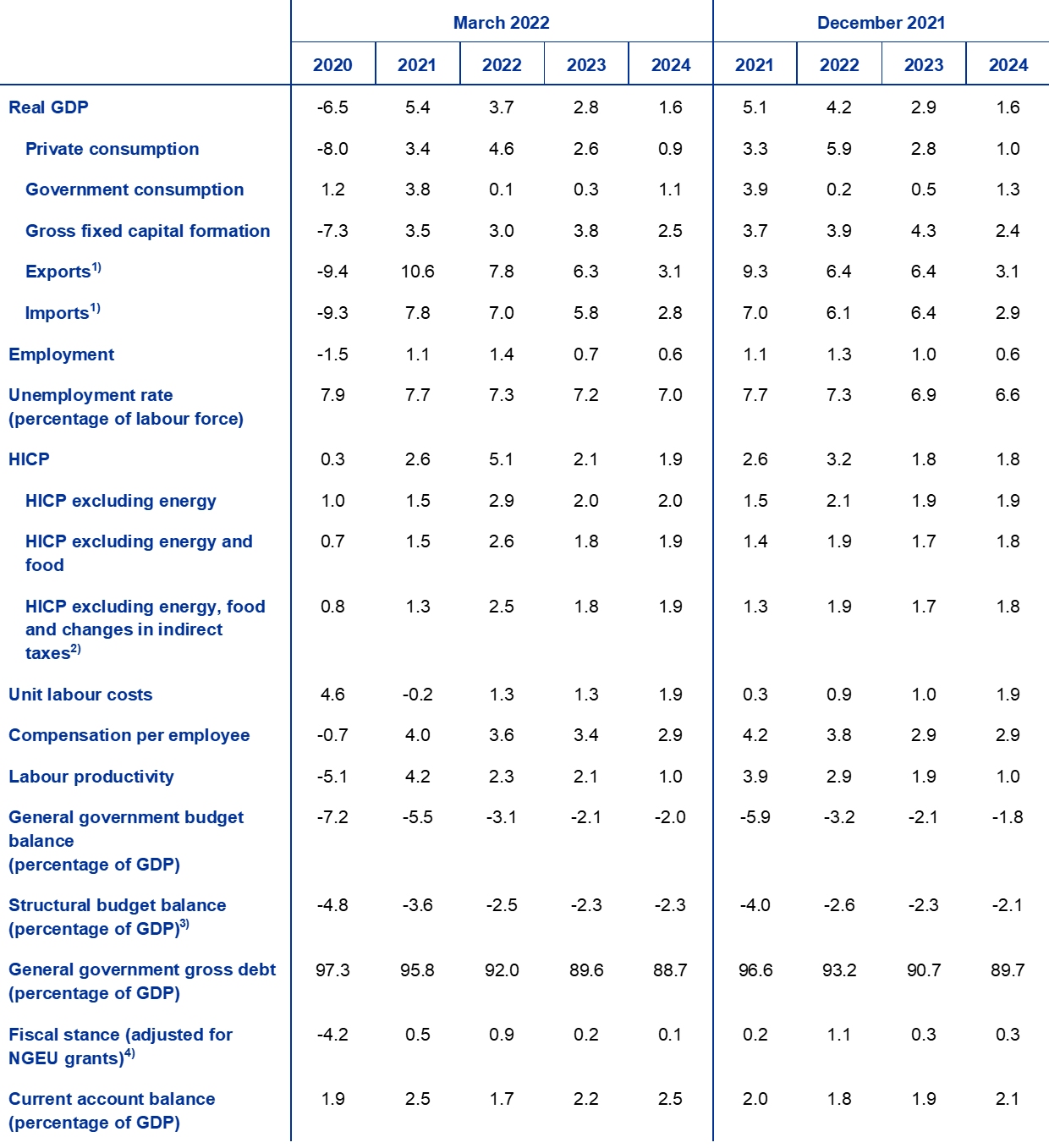
Notes: Real GDP and components, unit labour costs, bounty per employee and labour productivity refer to seasonally and working twenty-four hours-adapted data. Historical information may differ from the latest Eurostat publications due to data releases after the cutting-off date for the projections.
i) This includes intra-euro expanse trade.
ii) The sub-index is based on estimates of bodily impacts of indirect taxes. This may differ from Eurostat data, which assume a total and immediate laissez passer-through of indirect taxation impacts to the HICP.
iii) Calculated as the government balance internet of transitory furnishings of the economic bike and measures classified nether the European System of Fundamental Banks definition as temporary.
4) The fiscal policy stance is measured every bit the modify in the cyclically adjusted primary balance net of government support to the fiscal sector. The figures shown are besides adjusted for expected Next Generation European union (NGEU) grants on the revenue side. A negative figure implies a loosening of the fiscal stance.
Private consumption is projected to recover in the course of 2022, despite the increased doubt due to the conflict in Ukraine, and to remain the main driver of growth over the horizon. Confronting the backdrop of tighter pandemic-related restrictions – especially in contact-intensive services – and rising energy prices, private consumption contracted more than expected in the fourth quarter of 2021 and stood ii.v% beneath its pre-pandemic level. The higher free energy prices weighing heavily on households' purchasing ability also implies a likely wrinkle in private consumption in the first quarter of 2022. Thereafter, private consumption is projected to increment, albeit more moderately than previously expected, reflecting some precautionary saving and further energy price rises due to the war in Ukraine. The choice-upward in private consumption is based on the assumptions of a gradual resolution of the pandemic, an easing of supply constraints for consumer goods and merely a temporary disruption to energy supplies every bit a result of the disharmonize in Ukraine. Consumption should go along to outstrip the path of real income in 2023 owing to a further unwinding of savings accumulated since early 2020.
Strong labour income is supporting growth in real disposable income, while higher aggrandizement rates and the withdrawal of fiscal transfers are interim as a elevate. Real disposable income is expected to decline strongly in the start quarter of 2022 on the dorsum of higher aggrandizement and lower net fiscal transfers. A rebound is foreseen from the 2nd quarter of the year, shaped by improving labour markets and, to a lesser extent, other personal income, in line with moderate growth in economic activeness. In contrast, net fiscal transfers are expected to weigh on income growth in 2022 equally the number of people in job retention schemes decreases – with workers more often than not transitioning back to regular employment – and other temporary pandemic-related fiscal measures expire. This is partly offset by new measures aimed at compensating for the impact of high energy prices. High aggrandizement is dampening real disposable income more strongly than previously expected, thus contributing to its decline in 2022.
The household saving ratio is projected to reject to below its pre-crunch level, before stabilising towards the stop of the projection horizon. The saving ratio is expected to fall throughout 2022, revised slightly downward since the previous projections. While the conflict in Ukraine raises doubtfulness, which would typically be expected to lead to an increase in precautionary savings, this effect is more than offset by households' use of savings to cushion, at to the lowest degree partially, the negative furnishings of the energy shock on real consumption growth. The normalisation of consumers' saving behaviour reflects the relaxation of containment measures and a dissipation of pandemic-related precautionary motives. The saving ratio is projected to broadly stabilise beneath its historical average level as of mid-2023. The persistent, albeit slight, undershooting of its historical average reflects the fractional unwinding of excess household savings that have accumulated since the offset of the pandemic. However, this issue is attenuated by the doubtfulness caused by the events in Ukraine and by the concentration of backlog savings in wealthier and older households with a lower propensity to consume, while households in the lower income groups remain more exposed to the energy toll shock, besides in the light of their lower buffers.[2]
Box 1
Technical assumptions about interest rates, commodity prices and exchange rates
Compared with the December 2021 projections, the technical assumptions include significantly college oil and not-oil energy prices and higher interest rates. The technical assumptions about interest rates and commodity prices are based on market expectations with a cutting-off date of 28 February 2022.[3] Brusque-term interest rates refer to the iii-month EURIBOR, with market expectations derived from futures rates. The methodology gives an boilerplate level for these brusk-term involvement rates of -0.iv% in 2022, 0.3% in 2023 and 0.7% in 2024. Market expectations for euro area ten-year nominal government bond yields imply an boilerplate annual level of 0.8% for 2022, gradually increasing over the projection horizon to i.ane% for 2024.[4] Compared with the December 2021 projections, market expectations for short-term interest rates accept been revised up by around 10, 50 and lxx ground points for 2022, 2023 and 2024, respectively, on the dorsum of expectations of a global tightening of monetary policy, supported by connected positive inflation surprises. This has too led to an upwards revision of long-term sovereign bond yields, of effectually l-60 basis points, over the projection horizon.
Every bit regards commodity prices, the price of a barrel of Brent rough oil is assumed to rise from USD 71.ane on boilerplate in 2021 to USD 92.half dozen in 2022, before declining to USD 77.2 by 2024. This path implies that, in comparison with the December 2021 projections, oil prices in Us dollars are nigh 20% higher for 2022, 14% college for 2023 and xi% higher for 2024, on the back of supply problems and the war in Ukraine. Since the cut-off date, energy prices have increased significantly. The impact of higher energy toll assumptions than those included in the baseline projections are reflected in the scenarios presented in Box three.
The prices of non-energy bolt in Usa dollars rose strongly in 2021 and are expected to rise more moderately in 2022 and to subtract slightly in 2023-24. Eu Emissions Trading Scheme (ETS) allowances are assumed, based on futures prices, to stand around €83 per tonne over the project horizon – an upward revision of around 11% since the December 2021 projections.
Bilateral exchange rates are causeless to remain unchanged over the projection horizon at the boilerplate levels prevailing in the 3 working days ending on the cut-off date of 28 Feb 2022. This implies an average commutation charge per unit of USD ane.12 per euro over the menses 2022-24, which is around one% lower than in the December 2021 projections. The supposition for the constructive exchange rate of the euro implies an appreciation of 0.3% since the December 2021 projections.
Technical assumptions

Housing investment is expected to remain positive in the brusk term and to moderate over the rest of the projection horizon. Housing investment increased slightly in the 4th quarter of 2021, broadly in line with expectations in the December 2021 projections, with shortages of both labour and raw materials weighing on housing market place activity. Despite the war in Ukraine, housing investment is projected to continue to grow in the brusk term confronting a properties of withal notable demand – supported particularly by potent need from higher-income households – and some tentative signs of easing supply constraints. Afterwards a short catch-upward phase, in which supply constraints are expected to ease more noticeably, growth in housing investment should moderate over the remainder of the projection horizon. Still, it will proceed to be supported by positive Tobin's Q effects and ascension dispensable income, while financing conditions will go somewhat less favourable.
Business investment is expected to increase over the projection horizon and to account for an increasing share of real Gdp, despite the conflict in Ukraine, as supply bottlenecks ease and NGEU funds are disbursed. After the temporary drop in business investment observed in the third quarter of 2021, mostly caused past supply-side bottlenecks, concern investment is estimated to accept returned to more than dynamic growth in the concluding quarter of 2021. In the short term, despite the increased incertitude and financial market volatility due to the conflict in Ukraine, still high business confidence and capacity utilisation, as well equally a better assessment of upper-case letter goods producers' social club books, point to sustained positive growth. Equally the supply disruptions ease, investment is expected to maintain a dynamic growth path, although the commodity price increases, negative confidence effects and merchandise disruptions related to the conflict are likely to act as a elevate. The positive impact of the NGEU programme and projected turn a profit growth in 2022 and across are besides expected to provide support to business concern investment over the projection horizon. In addition, college expenditures related to the decarbonisation of the European economy will provide an boosted boost to business investment in the medium term. As a result, business organisation investment should business relationship for an increasing share of real Gdp over the projection horizon.
Box 2
The international environment
The global economy remains on a robust growth path, although the disharmonize in Ukraine and, to a bottom extent, the spread of the Omicron coronavirus variant cloud the outlook. At the plow of the year, the spread of the new Omicron variant caused an unprecedented increase in the number of coronavirus (COVID-19) infections worldwide. Equally available testify suggests that the Omicron wave will be shorter than previous waves, the impact on the global economy is expected to be rather moderate and limited to the first quarter of 2022. At the same time, the Russian invasion of Ukraine is weighing on the global economy. The imposition of substantial financial and trade sanctions on Russia has led to a significant downgrading of the country's growth outlook over the projection horizon (see Box 3). In improver to being channelled by trade linkages, knock-on effects are being felt by other countries through higher free energy prices, thus further reducing households' disposable incomes, and negative confidence effects, which will counterbalance on domestic demand and trade.
Supply bottlenecks remain a headwind to growth, merely recent indicators tentatively suggest some moderate easing since the end of 2021. Global PMI suppliers' delivery times have been improving slightly simply remain fairly tight past historical standards and are still long, while ocean shipping congestion remains high. At the same fourth dimension, given the potent growth in goods trade and machine production in contempo months, it appears that supply constraints in some sectors may have passed their height. Overall, supply bottlenecks are assumed to ease gradually in the form of 2022 and to have fully unwound by 2023 every bit consumer demand switches back from goods to services and shipping chapters and the supply of semiconductors increase on the back of planned investment. Nevertheless, there are risks – especially in the short term – that supply disruptions might intensify again. This could be the case if China sticks to its zero-COVID policy with the more infectious Omicron variant. Moreover, the war in Ukraine could crusade bottlenecks to worsen, leading to shortages of commodities and critical raw materials, but also impediments in logistics and transportation in view of flight and shipping bans affecting merchandise across the region.
Over the medium term, the global economy is projected to go on its expansionary path, albeit at more moderate rates, among geopolitical tensions and the unwinding of the pandemic-related policy stimulus. In 2021 global growth was underpinned by continued policy support. Still, since the Dec 2021 projections, growth has been revised upwards owing to a improve than expected outturn in the 2nd one-half of the year, particularly in big economies such equally People's republic of china and the The states. From 2022 onwards, global existent GDP (excluding the euro surface area) is projected to converge to more than moderate growth rates. Besides the impact of the Omicron variant and the Russian invasion of Ukraine, private consumption is expected to remain subdued amid ascent inflation. Further ahead, "speed limit" effects are expected on account of tighter labour marketplace weather, which volition be partly counterbalanced by the expected dissipation of supply bottlenecks. Diminishing policy support is also projected to limit growth over the projection horizon. Faced with strong inflationary pressures, central banks in some emerging market economies started to unwind their pandemic-related stimulus in 2021. In 2022, monetary policy accommodation is already being – or is presently expected to be – withdrawn also across advanced economies. Since December 2021 the Banking concern of England has raised interest rates twice and, in the U.s.a., the Federal Open Market Committee has signalled a shift in its policy opinion, hinting at a faster pace of normalisation in Us monetary policy than previously expected. Growth is therefore projected to decelerate in the United States, also on account of a smaller than previously assumed fiscal stimulus. Amongst emerging market economies, growth is projected to slow in Brazil, owing mainly to ambitious monetary policy tightening amidst ascension inflationary pressures, and Turkey, which has experienced marketplace turmoil related to high policy uncertainty and very high aggrandizement, adversely affecting consumption and investment. While the emergence of new, more than aggressive coronavirus variants cannot be ruled out, the influence of the pandemic on the global outlook is causeless to be gradually diminishing. Compared with the December 2021 projections, real Gross domestic product growth has been revised down over the projection horizon (-0.four percentage points for 2022, -0.iii percentage points for 2023 and -0.ane pct points for 2024). In the short term, the adverse touch on of the in a higher place-mentioned factors is partly showtime by a positive bear-over outcome, while further into the project horizon the downwardly revision relates to weaker growth in the United States and Russian federation, as well as in some other large emerging market place economies.
Subsequently buoyant growth in 2021, growth in euro area foreign need is projected to normalise gradually over the projection horizon. In the second half of 2021 global trade turned out stronger than expected, all the same supply concatenation disruptions, driven by robust developments in emerging Asia (mainly Communist china and India) and, in the fourth quarter, the United States. Survey data point to rather subdued merchandise growth at the turn of the twelvemonth, partly on account of the resurgence of the pandemic, merely this is expected to be temporary. For 2022, a positive bear-over outcome more than offsets the weaker dynamics stemming from the revisions to global activity and the adverse furnishings of the conflict in Ukraine, which results in a significant upward revision to growth in global imports for 2022 compared with the December 2021 projections. Euro expanse strange demand is unrevised for 2022, since the potent positive carry-over upshot is fully showtime past weaker trade on account of the conflict in Ukraine, while it is revised down for 2023 and 2024 (-1.1 percentage points and -0.3 percentage points respectively).
The international environment
(almanac percentage changes)

1) Calculated as a weighted average of imports.
ii) Calculated as a weighted average of imports of euro surface area trading partners.
The conflict in Ukraine is slowing the recovery in merchandise in the brusque term, although momentum is expected to strengthen afterwards in 2022. Post-obit signs of recovery in euro expanse foreign demand at the end of 2021, the war in Ukraine is denting the near-term prospect for euro area exports. Some gains in price competitiveness and the expected recovery in services merchandise should partly offset the headwinds related to the disharmonize. As a consequence, quarterly growth rates in euro area exports have been revised down in 2022. Nonetheless, the almanac growth rate has been revised upwardly, on the back of positive carry-over effects from upward revisions in the 2d half of 2021. On the import side, a short-term dampening of euro expanse activity dynamics is likely to result in lower growth rates. Net exports are therefore expected to contribute only mildly to GDP growth in 2022. The brusk-term outlook nevertheless remains overcast by significant downside risks related to supply bondage disruptions acquired by shortages of fundamental inputs from Russia. If the furnishings of the conflict, supply constraints and pandemic-related restrictions unwind, starting in the second one-half of 2022, euro area trade will return to its long-term growth path. Strong increases characterise trade deflators post-obit the free energy price daze, particularly on the import side, and will persist throughout 2022. These are also likely to entail a large deterioration in euro area terms of trade and the trade balance, which are expected to normalise only from 2023.
The labour market continues to strengthen. Employment grew by 0.5% in the fourth quarter of 2021, with a further turn down in the unemployment charge per unit. Employment is projected to grow further over the project horizon despite some downward pressures from the increased uncertainty due to the war in Ukraine. In addition, the unemployment rate is likely going to be adversely affected in the brusque term, but in annual boilerplate terms it is projected to reject to vii.0% past 2024. This decline is driven mainly past the projected stiff labour demand in line with the ongoing economic recovery.
Labour productivity growth is projected to decline gradually over the projection horizon towards its long-term average. After a temporary dip related to the deceleration in economic activity, labour productivity is expected to regain momentum equally a result of stronger economic growth and to normalise gradually thereafter towards its long-term pre-pandemic average. Past the end of the projection horizon, labour productivity (per person employed) is expected to exist around four.6% in a higher place its pre-crisis level.
Compared with the December 2021 projections, real Gross domestic product growth has been revised downwards by 0.5 percent points for 2022 and by 0.1 percent points for 2023, and is unrevised for 2024. The downgraded outlook for 2022 largely reflects the impact of the Ukraine crunch on free energy prices, confidence and trade, and is partly offset by a positive carry-over result from up data revisions for 2021. In 2023 and 2024, upward impacts from price competitiveness gains related to higher toll pressures in some fundamental trading partners are broadly offset past higher involvement rate assumptions and a negative impact of higher energy prices.
Box 3
The impact of the conflict in Ukraine on the euro area economic system in the baseline and two alternative scenarios
The Russian invasion of Ukraine is expected to significantly affect the euro area economy through three main channels: merchandise, bolt, and confidence. Beginning, trade with Russia is affected by bans on imports and exports, also every bit the adverse effects of the state of war on the Russian economy. The exclusion of Russian banks from SWIFT impairs merchandise financing of Russian firms, translating into extensive merchandise disruptions. In addition, a combination of higher involvement rates, upper-case letter outflows, financing constraints, deterioration of business concern sentiment, rising import prices and rouble depreciation is weighing on Russian Gross domestic product. While the direct touch on the euro expanse economy is limited, with Russia bookkeeping for a small share of euro area foreign demand (effectually three%; Chart A, left-paw panel), the spillovers to the global economic system – notably via countries with stronger trade links with Russia, such equally those in primal and eastern Europe – weaken the external outlook for the euro surface area more broadly. Second, the outbreak of the conflict has put significant upwardly force per unit area on commodity prices – already affected by the growing geopolitical tensions in the course of 2021 – beyond that already embedded in the baseline of the March 2022 projections. The bear upon on the euro area is sizeable, every bit Russia is its primary free energy provider, accounting for xx% of its oil and 35% of its gas in 2020 (Chart A, right-manus panel). While energy sector sanctions have then far been imposed only by non-euro surface area countries, consumers are increasingly reluctant to buy Russian oil, major companies are divesting Russian oil assets, and banks and insurance companies are increasingly unwilling to finance and insure Russian bolt trade. Finally, the war in Ukraine is eroding global confidence, which in turn is increasing volatility and gamble premia in global financial markets. This worsening of financial conditions for euro expanse firms, together with sustained geopolitical tensions and doubt, is expected to affect investment.
Chart A
Euro area merchandise with Russia (left-hand panel) and euro area dependence on Russian free energy supplies (correct-hand panel)
(left-hand panel: percentage of total merchandise in goods and services; right-mitt panel: percentage of imports)
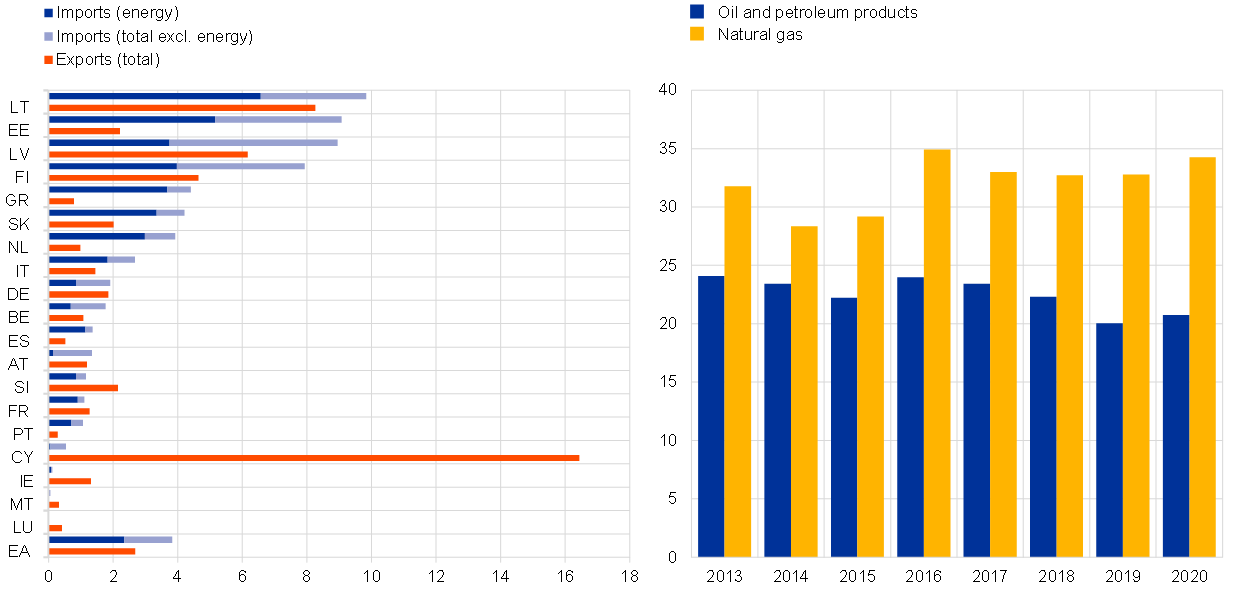
Sources: ECB, Eurostat and ECB staff calculations.
Note: Imports of natural gas include those of liquefied natural gas.
The high doubt surrounding the effects of the war in Ukraine on the euro area economic outlook warrants additional scenario analysis. The baseline projections are built on the assumptions that current disruptions to energy supplies and negative impacts on conviction linked to the disharmonize are temporary and that global supply chains are not significantly affected. Combined with the sanctions and the deterioration in global adventure sentiment, an free energy supply disruption is estimated to counterbalance on euro area existent Gdp growth in 2022 and to hamper activeness all the same in 2023, before a small upward impact in 2024 on account of catch-upward effects. As regards HICP inflation, the impact of the conflict on the baseline of the March 2022 projections is expected to be upwardly in 2022 on the back of rising commodity prices only, every bit the effect progressively fades away, to be muted in the outer years. This view is based, however, on the assumption that the war in Ukraine does not escalate significantly further and that existing sanctions against Russia remain in place over the full projection horizon. 2 scenarios (an "adverse" scenario and a "severe" scenario) accept been synthetic, differing according to sanctions, trade, confidence and energy supply disruptions, but also to the implications of fiscal disruptions and likely reactions. The effects on the euro expanse are estimated through model-based simulations.[five] It should be noted that in both culling scenarios it is causeless that the touch of the conflict volition be most pronounced in 2022 and that in that location volition be a resolution of the conflict over time. In this respect, more negative scenarios could be designed.[half-dozen]
Compared with the March 2022 projections, the adverse scenario assumes a worsening in all three channels (trade, commodities and confidence) and, in particular, constraints in the production capacity of the euro expanse. On the trade channel, more stringent sanctions entail a more astringent drag on the Russian economy. These sanctions also create broad supply constraints and disruptions to global value bondage. On the commodity prices channel, the scenario assumes a complete and lengthy cut-off of Russian gas to Europe, which the euro area is merely able to partly compensate for past using other free energy sources and through liquified natural gas commutation. Such a supply shortfall pushes gas prices sharply higher. Similarly, oil supply from Russia is severely disrupted, also pushing prices upward. In improver, the interruption of gas supplies is assumed to trigger cuts in sectoral production across the euro surface area. Besides the energy sector, whose production is directly affected, other sectors relying heavily either straight or indirectly on gas (e.g. transportation, mining and quarrying, and chemic products) would be adversely affected every bit the shock propagates and amplifies downward the supply chain.[seven] Over time, the gas market place is assumed to rebalance, leading to a gradual pass up in gas prices and a resumption of production. On the conviction aqueduct, stricter sanctions and more than sustained geopolitical tensions than those embedded in the baseline pb to a more severe and protracted ascent in global uncertainty and additional fiscal disruptions that affect some asset categories more persistently. This in turn further depresses risky nugget prices and increases volatility. Finally, this scenario adds moderate financial distension effects attributable to a general increase in run a risk premia, leading to higher external financing costs for euro area firms and weighing on investment.
In addition to the assumptions encapsulated in the agin scenario, the severe scenario entails a steeper and more than persistent ascension in commodity prices, triggering second-round effects from higher aggrandizement and broader financial amplification effects. In the astringent scenario, gas prices are assumed to exist twice as sensitive to Russian gas supplies being cut off as in the agin scenario, given the drawdown of inventory stocks and a continued tight gas marketplace. This entails more than severe upward price pressures, which are too expected to be somewhat more than persistent because Russian gas is causeless non to be entirely substitutable over the project horizon. Equally a result, the gas market place rebalances at more elevated price levels. There is also a sharper increase in oil prices and a higher subsequent cost level. On the confidence channel, this scenario assumes larger financial amplification effects, with a shock three times the magnitude of that assumed in the adverse scenario. Finally, this scenario includes larger 2nd-round effects in the context of an overall higher inflation surroundings.
The overall impact for the euro area is significantly negative on real Gdp growth, with a larger and more persistent effect under the severe scenario (Table and Chart B). In the adverse scenario, weaker foreign demand, higher commodity prices, heightened uncertainty, repricing in financial markets and product cuts lower existent GDP growth by around 1.ii percentage points in 2022 and 0.one percentage points in 2023 compared with the baseline. In 2024, growth is 0.5 percentage points higher than the baseline equally the economy catches up after the larger negative affect on economic activity in 2022 and 2023. In the severe scenario, as well the mechanisms at play under the adverse scenario, the higher energy prices, along with a further increase in spreads on financial markets, pb to significantly lower existent Gdp growth compared with the baseline (-ane.4 percentage points in 2022 and -0.5 percentage points in 2023). In 2023, the more persistent disruptions related to the war imply that the catch-up effects on growth would be limited, with growth 0.iii percentage points college in 2024.
Table
Alternative macroeconomic scenarios for the euro expanse
(annual percentage changes)

Inflation would reach very high levels, on average, in 2022 nether both scenarios simply subtract progressively thereafter to stand in 2024 beneath the baseline of i.9% in the adverse scenario and at the baseline level in the severe scenario (Table and Chart B). Assumptions about energy prices are the dominant driver for HICP inflation. The higher sensitivity of energy prices to supply cuts and the fewer offsetting factors under the severe scenario lead to a higher and more prolonged surge in HICP inflation. Equally such, the inflationary furnishings due to higher commodity prices corporeality to 0.viii pct points in 2022 in the adverse scenario and to 2.0 percentage points in the severe scenario. In 2023, the upward pressures persist in the severe scenario, with HICP inflation 0.half dozen percentage points higher than the baseline. Every bit oil and gas markets rebalance, the large spikes in energy prices gradually unwind, leading, with weaker euro area action, to lower inflation. In the astringent scenario, more elevated energy prices as well as stronger 2d-round effects accept HICP inflation back to the baseline rate of ane.9% in 2024.
Nautical chart B
Impact of alternative scenarios on real Gdp growth and HICP inflation in the euro expanse compared with the baseline
(deviations from the March 2022 baseline projections, in percentage points)
Source: ECB staff calculations.
However, these scenarios abstract from a number of factors that may also influence the magnitude and the persistence of the impact. In particular, these scenarios have been prepared under the same fiscal assumptions as those of the March 2022 projections. As in 2021, governments may accept action to cushion the impact of large energy prices hikes on consumers and firms. In addition, the estimated impact of gas supply interruptions on production does non consider commutation, which could lead to an issue that is not as strong every bit assumed in the scenario. On the other hand, an escalated and more protracted conflict entails the risk of a more than pronounced and persistent impact. In addition, besides the energy cost hikes included in the scenarios, other commodity prices such as food prices and some selected metal prices might besides be severely affected by the conflict given the role of Russia and Ukraine in global supplies of these commodities.
2 Fiscal outlook
Some further financial stimulus measures have been incorporated into the baseline since the Dec 2021 projections. After the stiff expansion in 2020, the euro area fiscal stance adjusted for NGEU grants is estimated to take tightened in 2021. This is mostly on account of revenue "windfalls" and other factors, which often manifest during a recovery. The fiscal opinion is currently projected to tighten further in 2022, on account of the reversal of a pregnant function of the pandemic emergency support, and to a much lesser extent over the residuum of the projection horizon. Compared with the December 2021 projections, the fiscal stance is expected to be around 0.two percentage points of GDP looser in 2022 and broadly unchanged over 2023-24. For 2022, the revisions reverberate, among other things, additional stimulus measures adopted by governments in response to the Omicron wave and new measures to compensate for higher energy prices, besides every bit a partial reversal of revenue windfalls from 2021. This additional financial impulse is partly compensated for past more subdued growth in expenditure, particularly government consumption and transfers. Financial assumptions and projections are currently surrounded past a loftier degree of uncertainty related to the war in Ukraine, with the risks assessed to be tilted towards the introduction of additional stimulus.
The euro surface area budget balance is withal projected to improve steadily in the flow to 2024, but by less than foreseen in the Dec 2021 projections. The euro area upkeep deficit is estimated to accept remained high in 2021, having peaked in 2020. Over the projection horizon the substantial improvement in the budget balance is seen to be driven mainly by the cyclical component and the lower cyclically adjusted primary arrears. At the stop of the horizon the budget balance is projected to be -two% of GDP and thus to remain below the pre-crisis level. After the sharp increment in 2020, euro area aggregate government debt is expected to refuse over the entire projection horizon, reaching most 89% of GDP in 2024, which is in a higher place its pre-pandemic level. The turn down is seen to exist mainly due to favourable involvement rate-growth differentials, but likewise to arrears-debt adjustments, which together more than offset the persisting, albeit decreasing, main deficits. Compared with the Dec 2021 projections, the estimated budget residual outcome for 2021 has been revised significantly upwardly, reflecting both a higher revenue-to-GDP ratio and a lower expenditure-to-GDP ratio. Despite the college starting bespeak, the upkeep residual in 2024 is now projected to be lower than foreseen in December, following the deterioration in the macroeconomic outlook triggered by the war in Ukraine and the upward revisions to interest payments as a share of Gdp. The path of the euro area aggregate debt ratio has been revised downwardly over the entire projection horizon, mainly on business relationship of favourable base effects from 2021.
3 Prices and costs
Headline inflation reached 5.viii% in February 2022 and is projected to remain elevated over the coming quarters (Nautical chart 3). Inflation is being driven mainly by energy aggrandizement, which rose to around 32% in Feb, mostly on business relationship of higher gas and electricity tariffs. These 2 components are besides expected to sustain energy inflation at loftier rates over the course of the year. By dissimilarity, the contribution from fuels is expected to fade away in 2022 owing to base of operations effects and an assumed downward-sloping contour of oil prices. Electricity and gas tariffs recorded a large month-on-month increase in January, with prices existence reset for the new year's day in many countries, and further increases are expected in the class of the year as the surge in wholesale gas futures prices caused past the war in Ukraine is gradually passed on to consumers (although base furnishings imply some declines in almanac aggrandizement rates afterward in the year). HICP inflation excluding energy and food is expected to exist ii.vi% in 2022, attributable to high demand, indirect effects from higher energy prices and price pressures along the pricing chain related to supply bottlenecks. Food inflation increased to iv.1% in February and is expected to remain high throughout 2022, attributable to high article prices and extraordinary increases in gas and electricity prices, which account for around ninety% of the full energy costs of the processed nutrient industry and are an important factor for the production of fertilisers. Headline aggrandizement is expected to refuse in the 2nd half of the year on the dorsum of large negative base of operations effects and an assumed downward-sloping profile of oil prices.
HICP inflation is expected to decline from an boilerplate of 5.1% in 2022 to ii.1% in 2023 and 1.nine% in 2024. This reject in headline inflation over the projection horizon reflects sharp declines in energy inflation in line with the supposition that oil and gas prices will follow the downward-sloping profile of their respective futures curves despite some upward touch on from i) the reversal in 2023 of temporary financial measures to reduce energy prices, ii) national climate change measures in 2023-24, and 3) lagged furnishings of earlier strong increases in wholesale gas prices. Food inflation is also expected to decrease over the project horizon. HICP aggrandizement excluding energy and food is projected to ease somewhat to stand at 1.8% in 2023, so to increment to 1.ix% in 2024. The initial easing results from the unwinding of upward impacts from supply bottlenecks every bit they are resolved and from the effects of the reopening of the economy, as well as base effects. While the adverse touch on growth from the war in Ukraine might accept some dampening furnishings, these are likely to exist offset by indirect effects from the higher free energy prices triggered by the disharmonize. The slight increment in 2024 is in line with a tightening of product and labour markets, some second-round furnishings on wages from the inflation spike in 2021 and 2022, likewise equally longer-term aggrandizement expectations being anchored at the ECB'due south inflation target of 2%. The baseline projections are surrounded past pregnant dubiousness on account of the state of war in Ukraine, especially given the stiff further increases in energy prices since the underlying technical assumptions were finalised. The culling scenarios presented in Box 3 embed high energy prices.
Growth in compensation per employee is projected to exist three.6% in 2022 and to reject to two.nine% in 2024, remaining above the historical boilerplate recorded since 1999 (two.2%). Although compensation per employee, which was greatly distorted past policy measures in 2021, is envisaged to subtract somewhat, unit labour costs are expected to increment, driven by lower growth in productivity per person employed. The above average wage growth reflects the tightening labour market, the expected increment in the minimum wage in Germany in October 2022 and some second-round furnishings from the high rates of inflation.
Chart 3
Euro expanse HICP
(annual percentage changes)

Annotation: The vertical line indicates the start of the projection horizon.
External price pressures are expected to be significantly stronger than domestic price pressures in 2022 just to drop to considerably lower levels in the later on years of the projection horizon. The almanac growth rate of the import deflator is expected to exist eight.2% in 2022, largely reflecting increases in oil and non-energy commodity prices simply also some increases in input costs related to supply shortages. As of 2023, import cost growth is expected to moderate and to stand at 0.7% in 2024.
Compared with the Dec 2021 projections, the outlook for HICP aggrandizement has been revised upwardly by 1.9 percentage points for 2022, 0.3 percentage points for 2023 and 0.1 pct points for 2024. Three-quarters of the cumulative revision relates to the volatile free energy and nutrient components, while the remaining one-quarter relates to the projection for HICP inflation excluding energy and food. These revisions reflect recent upward data surprises, stronger and more persistent upward pressures from free energy prices (stemming from the conflict in Ukraine) and supply disruptions, and stronger wage growth, as well related to the planned increase in the minimum wage in Germany. The upward revision also took into account the contempo return of survey-based indicators of medium-term aggrandizement expectations to levels consequent with the ECB's inflation target. In the outer years of the projections, these effects more than than offset the negative impact on inflation of a significant upward revision to the marketplace-based assumptions on interest rates and the negative demand-related furnishings of the conflict in Ukraine.
Box 4
Forecasts past other institutions
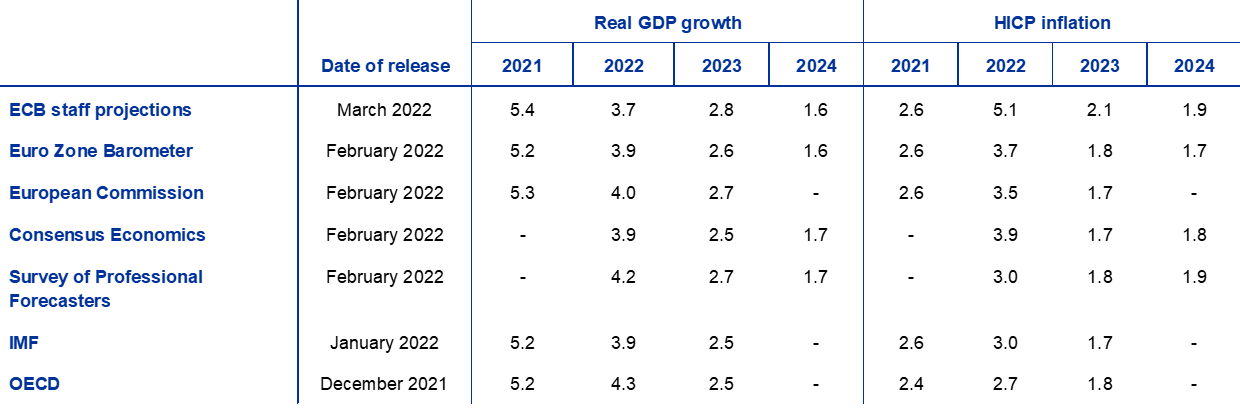
A number of forecasts for the euro area are available from both international organisations and individual sector institutions. Notwithstanding, these forecasts are not directly comparable with 1 another or with the ECB staff macroeconomic projections, as these were finalised at different points in time. Importantly, none of the comparator forecasts currently include the impact of the state of war in Ukraine. Additionally, these projections utilize unlike methods to derive assumptions for financial, fiscal and external variables, including oil and other commodity prices. Finally, in that location are differences in working day adjustment methods beyond different forecasts (encounter the table).
Comparison of recent forecasts for euro area real GDP growth and HICP inflation
(annual percentage changes)
Sources: MJEconomics for the Euro Zone Barometer, 24 February 2022, information for 2024 are taken from the January 2022 survey; European Committee Wintertime 2022 Economic Forecast (Acting), 10 February 2022; Consensus Economic science Forecasts, 10 February 2022, information for 2024 are taken from the January 2022 survey; ECB Survey of Professional person Forecasters, for the commencement quarter of 2022, conducted betwixt vii and 13 January; IMF World Economic Outlook Update, 25 Jan 2022; OECD December 2021 Economic Outlook 110.
Notes: The ECB staff macroeconomic projections report working solar day-adapted annual growth rates, whereas the European Commission and the International monetary fund report annual growth rates that are not adapted for the number of working days per annum. Other forecasts exercise not specify whether they study working 24-hour interval-adjusted or not-working day-adapted data. Historical data may differ from the latest Eurostat publications due to data releases after the cut-off engagement for the projections.
The March 2022 ECB staff projections are below those of other forecasters for growth in 2022, while for aggrandizement in 2022 they are well above other forecasts, owing to the inclusion of the touch of the conflict in Ukraine and more contempo information. For the outer years of the horizon, the differences are more express. Despite the downwards revision compared with the December 2021 Eurosystem staff project for growth in 2022, the March 2022 ECB staff projection is just slightly below other more recent projections for 2022 and is nonetheless somewhat higher up other forecasts for 2023. Every bit regards inflation, the ECB staff projection is far higher than the other forecasts for 2022 owing to the more contempo cutting-off engagement, which made information technology possible to include the Feb 2022 HICP flash estimate and more than upward-to-appointment technical assumptions following the Russian invasion of Ukraine. For 2024, the ECB staff projections are within a much narrower range of other forecasts for both growth and inflation.
© European Cardinal Depository financial institution, 2022
Postal address 60640 Frankfurt am Main, Germany
Telephone +49 69 1344 0
Website www.ecb.europa.eu
All rights reserved. Reproduction for educational and non-commercial purposes is permitted provided that the source is acknowledged.
For specific terminology please refer to the ECB glossary (available in English language but).
PDF ISSN 2529-4466, QB-CE-22-001-EN-N
HTML ISSN 2529-4466, QB-CE-22-001-EN-Q
Source: https://www.ecb.europa.eu/pub/projections/html/ecb.projections202203_ecbstaff~44f998dfd7.en.html
Belum ada Komentar untuk "“Economic growth will always lead to inflation.†To what extent is this a true premise?"
Posting Komentar